I’ve made enough crochet hats over the years to know exactly what happens when you skip the measuring step — you end up with a beanie that perches on top of someone’s head like a yarmulke, or one so snug it leaves a red line across their forehead by the end of the party. A solid crochet hat size chart fixes that before you’ve spent a single skein, and in this guide I’ll walk through the actual head circumference numbers, how to convert them into a finished hat size, and how to use all of it even if you’re working from a pattern that doesn’t include sizing at all.
I’ve been making hats on and off for about ten years, mostly gifts and a fair number of donation caps for a local hospital drive, which means I’ve had to size for babies, kids, and adults with wildly different head shapes more times than I can count.
Why a Size Chart Alone Doesn’t Finish the Job
A head circumference chart tells you how big someone’s head actually is. It does not tell you how big to make the hat, and mixing those two numbers up is the single most common sizing mistake I see, especially from newer crocheters following a pattern for the first time.
Crochet fabric, unlike a lot of knit fabric, has less natural stretch. That means a hat crocheted to the exact head circumference will usually feel loose or slide down, because there’s nothing pulling it snug against the head once it’s off the hook and finished. The standard fix is negative ease — making the hat’s actual finished circumference somewhere between 1 and 2 inches smaller than the head measurement, so the slight stretch in the fabric does the work of holding the hat in place.
How much negative ease you need depends partly on stitch pattern. A dense single crochet fabric has very little give, so it tends to want closer to 2 inches of negative ease. A more open or textured stitch, like a shell pattern, naturally stretches more and can get away with less, sometimes as little as half an inch to an inch.
The Crochet Hat Size Chart in Inches
Here’s the head circumference data I actually use, pulled directly from the Craft Yarn Council’s official head circumference chart rather than a number I’m guessing at. These are head measurements, not finished hat measurements — remember to subtract your negative ease before settling on a final hat circumference.
| Size | Head Circumference (inches) |
|---|---|
| Preemie | 9–12 |
| Baby | 14–16 |
| Toddler | 16–18 |
| Child | 18–20 |
| Tween | 20–22 |
| Woman | 21–23 |
| Man | 22–24 |
A few things worth noticing in this table. First, there’s a real overlap between the Tween and Woman categories — a lot of preteens and small-headed adults sit right in that shared 20–23 inch zone, so age alone isn’t always the most reliable way to pick a size if you can get an actual measurement instead. Second, these are ranges, not single numbers, because head size genuinely varies a fair amount even within a narrow age bracket. When I’m making a hat for someone I can’t measure directly, I generally aim for the middle of the relevant range rather than either extreme.
The Crochet Hat Size Chart in CM
If you’re working in metric, here’s the same chart converted to centimeters, again based on the Craft Yarn Council’s published figures rather than a rough inch-to-cm conversion done after the fact.
| Size | Head Circumference (cm) |
|---|---|
| Preemie | 23–30.5 |
| Baby | 35.5–40.5 |
| Toddler | 40.5–46 |
| Child | 45.5–51 |
| Tween | 51–56 |
| Woman | 53–58.5 |
| Man | 56–61 |
One small note on precision here: I’ve kept these to the same level of rounding as the original source rather than adding false precision by converting to more decimal places than the inch measurements actually support. A range like “53–58.5 cm” is genuinely as precise as this data gets, and stretching it out to more decimals wouldn’t make it any more accurate.
Free Crochet Hat Size Chart: Using It Without a Specific Pattern
If you’re not working from a pattern at all, or you’ve got a stitch pattern you love but no sizing instructions to go with it, this chart is genuinely usable on its own, provided you understand the two extra pieces that turn a head measurement into an actual hat.
Step one: pick your finished hat circumference. Take the head circumference from the chart (or, better, an actual measurement of the person you’re making the hat for), then subtract your chosen negative ease — 1 to 2 inches, depending on your stitch pattern’s natural stretch, as covered above.
Step two: figure out your stitch count from your own gauge. This is the part I can’t hand you a fixed number for, because it depends entirely on your yarn, hook size, and personal tension, all of which vary hook to hook and hand to hand. The general formula is: multiply your finished hat circumference by your stitches-per-inch gauge (measured from an actual swatch in your chosen stitch pattern), and that gives you your foundation stitch count for a hat worked from the brim up, or your target circumference to build toward if you’re working top-down from a crown.
Step three: figure out hat height. A reasonable starting point most patterns use is roughly one-third of the head circumference, though this varies with style — a slouchy hat runs longer, a tight skull cap shorter, and a folded brim adds a couple of extra inches on top of the base height. Again, this is something to confirm against your own gauge swatch and the specific look you’re going for, not a fixed number I’d want to hand you without a tested source behind it.
I know it’s tempting to want one clean set of numbers to just follow, but genuinely, gauge varies enough between crocheters — even using identical yarn and identical hook sizes — that handing you invented stitch counts here would set you up to make a hat that doesn’t actually fit. Swatching first, even just a small one, is the difference between a hat that works on the first try and one you have to frog and restart.
How to Actually Measure a Head
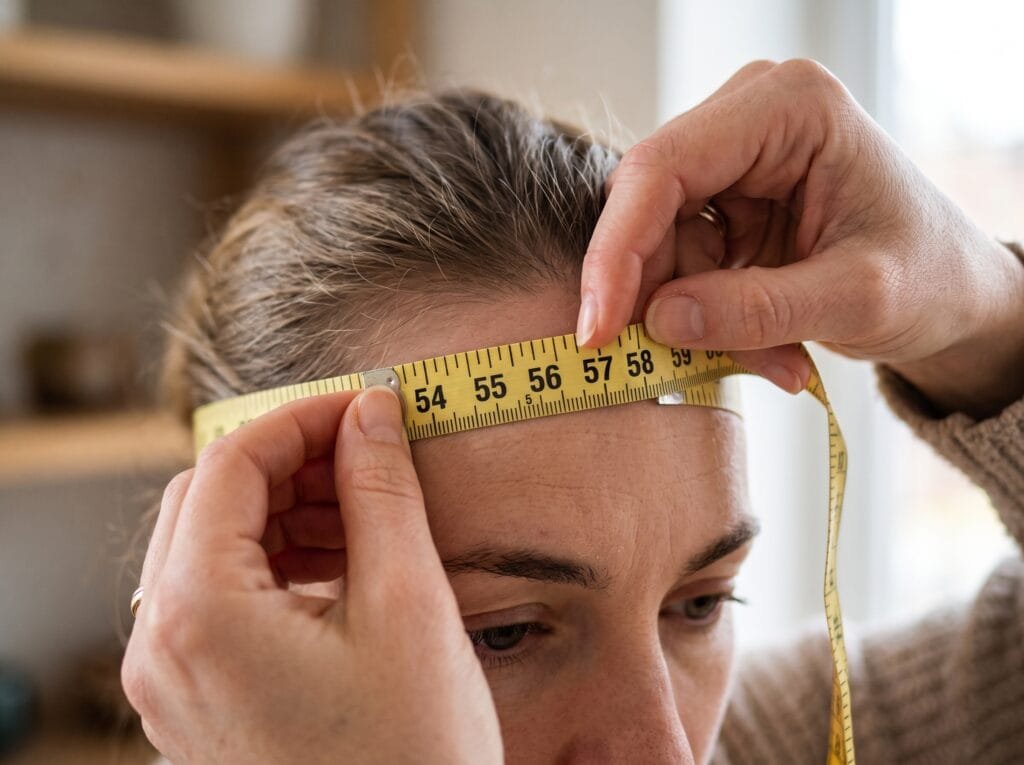
If you can measure the person the hat is for, always do that instead of relying purely on the chart — the chart exists for situations where measuring isn’t possible, like a surprise gift or a donation hat for someone you’ll never meet.
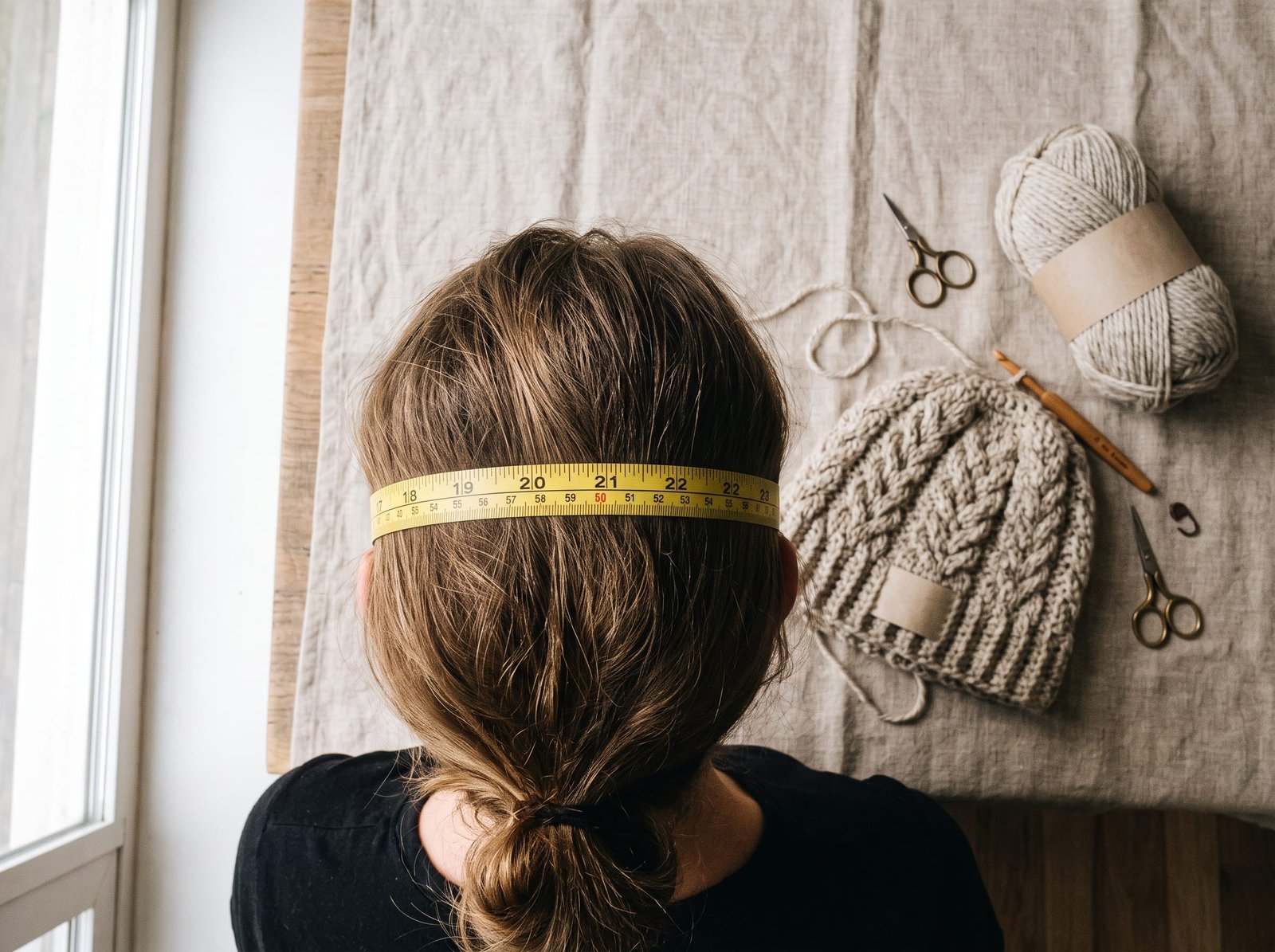
Wrap a soft measuring tape around the head at the widest point, which is typically about an inch above the eyebrows in front and around the fullest part of the back of the skull. Keep the tape level all the way around and snug against the head without pulling it tight enough to compress hair or skin.
If you don’t have a flexible tape measure, a length of string or ribbon works as a substitute — wrap it around the head the same way, mark or pinch where it meets itself, then lay it flat against a ruler or hard tape measure to get your number.
For babies and very young children who won’t hold still for measuring, I’ll admit I’ve had good luck measuring a well-fitting hat they already own instead, laid flat and doubled to get the circumference, rather than fighting a squirming toddler with a tape measure. It’s not a perfectly scientific method, but it’s a lot more accurate than guessing purely off age, and it’s spared me more than one tearful measuring session.
Turning the Numbers Into an Actual Hat
Once you’ve got your finished circumference and your gauge-based stitch count, actually building the hat comes down to a fairly standard structure regardless of which direction you work.
Top-down hats start with a small circle at the crown — usually 6 to 8 stitches in the first round if you’re working in single or half double crochet — and increase evenly round by round until the circumference matches your target measurement. From there, you work even rounds (no more increasing) until the hat reaches your target height, then finish the brim, plain or ribbed depending on the look you want.
Brim-up hats start with a foundation chain or foundation stitch row roughly matching your target circumference, join it into a round, and work straight up without shaping until you’re ready to decrease for the crown, typically over the last inch and a half to two inches of height.
Both structures land at the same finished hat, and which one you choose usually comes down to personal preference or whatever a specific stitch pattern is designed around, rather than one being objectively better than the other.
If you’re finishing off a hat and want a clean, non-bulky end at the crown, my how to fasten off crochet guide covers the invisible fasten-off method I use on basically every hat crown, since a standard fasten off tends to leave a visible little bump right at the very top where it’s hardest to hide.
Sizing for Donation and Charity Hats
If you make hats for donation drives — hospitals, shelters, charity organizations — sizing works a little differently than sizing for a specific person, since you’re often working somewhat blind, without a real head to measure or even fit against.
Most charity hat guidelines I’ve seen lean toward the middle of the adult range as a safe default, since donation hats more often go to adults than infants, and a hat sized too small is a much bigger problem than one sized slightly generous. If a specific charity has published its own sizing requirements, always follow those over a general chart, since some organizations have very specific circumference and yardage requirements tied to how they distribute items.
For baby and toddler donation hats specifically, I’ve found it worth erring very slightly larger rather than smaller within the given range, since a hat that runs a touch big can still be worn (maybe with a fold in the brim), while one that’s genuinely too small is unusable and becomes wasted yarn and time. This is really the one place I’d deliberately bend the “match the middle of the range” advice I’d otherwise give.
How Stitch Pattern Choice Affects the Chart’s Usefulness
The head circumference chart itself doesn’t change based on what stitch you’re using, but how much you trust the chart’s raw numbers absolutely should shift depending on your stitch pattern’s structure.
A tightly worked single crochet hat behaves almost like a fixed-size object once it’s off the hook — it has some give, but not a huge amount, so precision matters more here than with a stretchier stitch. If you’re making a single crochet hat and you’re between two sizes on the chart, I’d generally size up rather than down, since there’s less forgiving stretch to bail you out if you guess wrong.
A more open stitch — shells, clusters, anything with visible gaps — behaves more like a stretchy knit fabric, forgiving a wider range of actual head sizes from a single finished measurement. I’ve made shell-stitch slouchy hats that comfortably fit both my own head and my mother’s, despite a real difference in our actual circumference, purely because the stitch pattern itself has so much built-in stretch.
Ribbed brims, whether worked in true ribbing or a post-stitch pattern that mimics it, also add meaningful stretch right where the hat needs to grip the head most, which is part of why so many patterns put a ribbed band at the base even when the rest of the hat uses a firmer stitch.
What to Do When You’re Between Two Sizes
Because the chart works in ranges rather than single numbers, it’s genuinely common to end up with a measurement that sits right between two labeled categories — a nine-year-old with a 20.5-inch head, technically straddling the line between Child and Tween, for instance.
When that happens, I look at two things beyond the raw number: how the hat will be worn, and how much room the recipient is likely to need for growth if it’s a gift meant to last more than one season. A hat meant to be worn snug and low, covering the ears, benefits from sizing toward the smaller category. A slouchier style with more relaxed fit, or a hat intended to last through a growth spurt, does better sized toward the larger one.
If you genuinely have no other information to go on, I’ll default to the larger of the two neighboring categories rather than the smaller, simply because a slightly loose hat is more wearable and more forgiving than one that’s genuinely too tight — a too-small hat is essentially unwearable, while a too-large one can often still be worn, just with a bit less structure than ideal.
Common Sizing Mistakes I See (and Have Made Myself)
Ignoring negative ease entirely. I did this on one of my very first hats, working exactly to the head circumference number with zero ease subtracted, and ended up with something that slid straight down over the recipient’s eyes the first time they put it on. It’s a five-second subtraction that saves a genuinely frustrating do-over.
Using age instead of an actual measurement when one is available. Age ranges are useful placeholders, not guarantees. I’ve measured plenty of three-year-olds whose heads fit comfortably in the chart’s “child” range meant for kids twice their age, and it goes the other way just as often.
Forgetting that stitch pattern changes how much ease you need. A pattern that worked perfectly with 2 inches of negative ease in single crochet can end up too tight if you swap to the same stitch count in a denser, less stretchy stitch, or too loose if you swap to something with more natural give.
Assuming a “one size fits most” pattern actually fits everyone in that range. A hat sized for the middle of the Woman range (roughly 22 inches) will likely feel loose on someone at 21 inches and snug on someone at 23. If you know the actual person, it’s always worth adjusting slightly rather than trusting a single fixed number to cover the whole range.
Frequently Asked Questions
Is there a difference between a “baby” hat size and a “newborn” size, or are they the same thing? They’re often used somewhat interchangeably in casual pattern language, but the Craft Yarn Council’s chart specifically separates preemie from baby, with baby generally covering a wider window from newborn up through roughly the first year. If a pattern just says “newborn” without a specific circumference, it’s worth checking whether that lines up closer to the preemie or baby range on this chart before committing to a size.
My finished hat came out bigger than my swatch predicted. What went wrong? This usually comes down to tension drifting between a small swatch and a much larger piece worked in the round — some crocheters genuinely relax their tension slightly once they’re deep into a big project. It’s also worth double-checking that your swatch was worked in the same stitch pattern as the actual hat, since gauge can shift noticeably between, say, single crochet and half double crochet even at the same hook size.
Can I use this chart for a crocheted headband or ear warmer instead of a full hat? Yes, the head circumference numbers themselves work the same way, though ear warmers and headbands typically want more negative ease than a full hat, since they rely entirely on stretch and friction rather than also having a closed crown holding shape at the top.
Do adult hat sizes really only need two categories, Woman and Man? That’s genuinely just what the standard chart offers as a general reference — plenty of real adult heads fall outside a strict binary, and if you know the actual circumference of the person you’re making a hat for, use that number directly rather than picking whichever labeled category feels closest. The label is a starting point for estimation, not a rule about who’s allowed to wear which size.
Wrapping Up
A good crochet hat size chart takes a lot of the guesswork out of gifting a hat to someone whose head you can’t measure directly, but it’s really only the first half of the equation — negative ease and your own gauge do the rest of the work in making sure the finished piece actually fits. Measure when you can, swatch before you commit to a full hat, and don’t be afraid to land in the middle of a size range rather than chasing a single perfect number. Every hat I’ve gotten wrong over the years has taught me a little more about which of these factors mattered most for that particular yarn and stitch combination, and eventually that experience starts to matter more than any chart ever could.
If you’ve got a sizing trick of your own, or a too-big or too-small hat story to share (we’ve all made at least one), tell me about it in the comments. And if this chart saved you a guessing game, sharing it or following along for more sizing and technique guides keeps this kind of content coming.