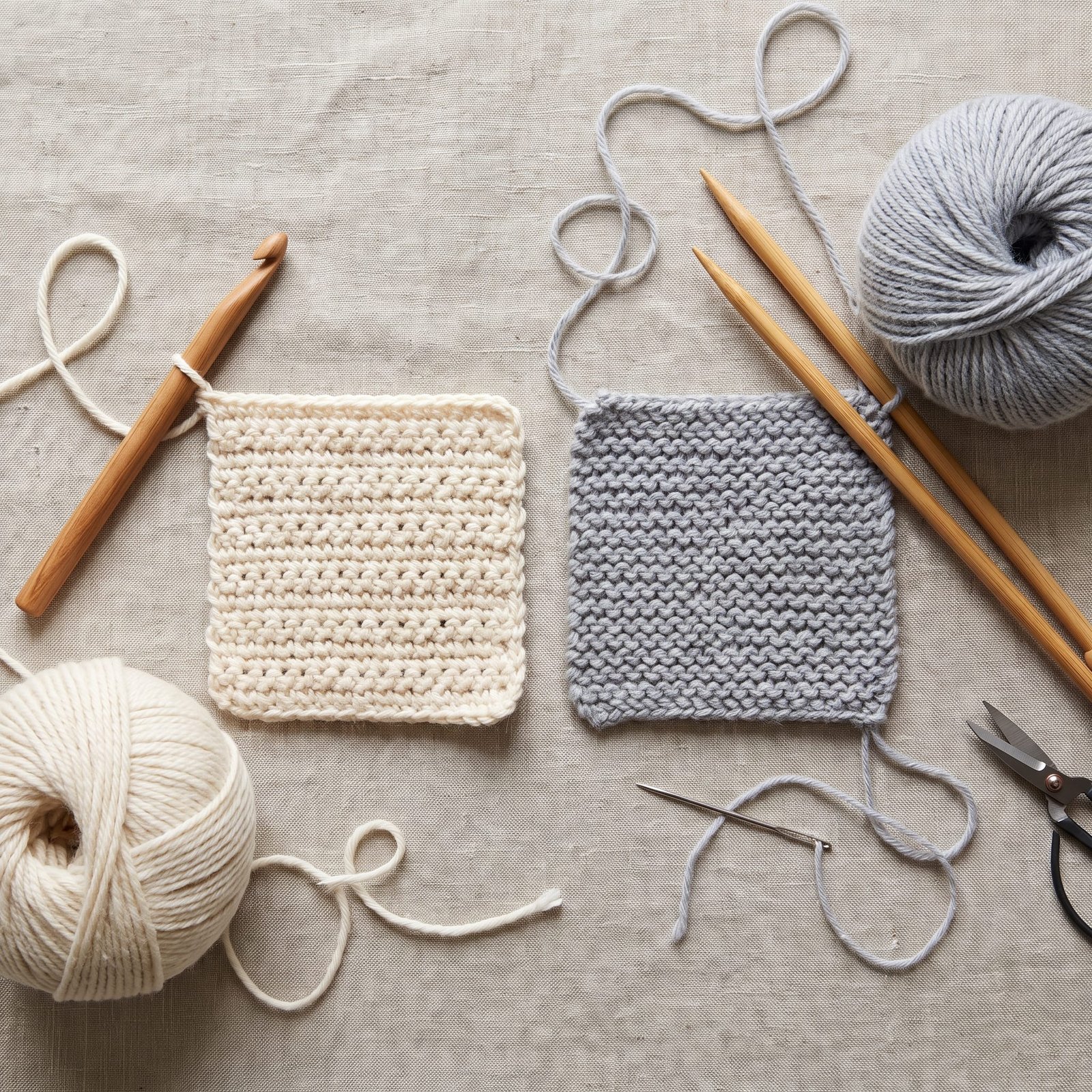
People ask me the knit vs crochet question constantly, usually right before picking up a hook or needles for the first time, and I get why — the two crafts look similar from across a room but feel completely different in your hands. In this guide I’ll walk through the real mechanical differences, which one tends to be easier to pick up, and what I’d actually tell a beginner trying to decide between them.
I’ve crocheted seriously for about twelve years and knit on and off for maybe four, enough to speak honestly about both, though I want to be upfront that crochet is where my real depth is. I think that’s worth knowing going into this, since plenty of comparison articles are written by someone who only really knows one side and is guessing at the other.
The Core Mechanical Difference
Crochet uses a single hook and works one loop at a time. At almost any point mid-stitch, you’ve only got one live loop on your hook (occasionally a few more during a specific stitch), which means if something goes wrong, you’re usually only unraveling a small, contained mistake.
Knitting uses two needles and keeps an entire row of stitches “live” at once, all sitting on the needle simultaneously until you work back across them. That structural difference is the reason a dropped stitch in knitting can be a genuinely bigger problem — a stitch that slips off the needle can start unraveling, or “laddering,” down through several rows before you notice, which almost never happens in crochet, where an unraveled stitch just stops at the last completed one.
According to the Craft Yarn Council, knitting is built around two basic stitches — knit and purl — worked alone or in combination to create most other stitch patterns, while crochet’s stitch vocabulary branches out more directly through hook and yarn manipulation itself, without needing to hold an entire row on a tool at once. That structural difference is really the root of almost every other distinction between the two crafts, from mistake-forgiveness to how portable a project feels mid-row.
Which Is Easier, Knitting or Crocheting? My Honest Take
I don’t think there’s a universally correct answer here, but I do have a genuine opinion, and it comes with a caveat I think matters more than the opinion itself.
For raw first-week ease, I’d put crochet ahead. You’re only ever managing one hook and one active loop, which means there’s less to juggle physically while your hands are still learning the basic motion. I’ve watched enough beginners in my library teaching group struggle with two needles at once, especially the fiddly business of keeping stitches from sliding off an idle needle, to say this pretty confidently.
Where that flips a little is in long-term motion efficiency. Knitting, once it clicks, tends to develop into a smoother, more continuous rhythm for a lot of people — you’re not re-inserting a hook into a completely new spot for every single stitch the way crochet requires. Several experienced knitters I know describe it as eventually feeling closer to a repetitive, almost meditative motion, more so than crochet does for them.
My honest opinion: crochet is genuinely easier to pick up in the first week or two. Which one is “easier” past that initial hurdle depends more on your own hands and patience than on any inherent property of either craft, and I’d be skeptical of anyone who tells you definitively that one is universally easier for everybody, long-term.
Knit vs Crochet for Beginners: What I’d Actually Recommend
If someone asked me cold, with zero other information about them, which craft to start with, I’d lean crochet for the reasons above — fewer moving parts, more forgiving mistakes, and a genuinely fast first project (most people can make a small square within their very first sitting).
But a few things would change my answer. If you already know you’re drawn to garment-making specifically — sweaters, socks, anything meant to closely fit a body — I’d point you toward knitting instead, since knit fabric’s natural stretch and drape genuinely suits close-fitting garments better than most crochet fabric does, and you’ll likely end up learning it eventually anyway if garment-making is the real goal.
If you have any hand or wrist conditions that make gripping tricky, it’s worth trying both briefly before committing, since some people find a single hook easier on their joints than balancing two needles, and others find the opposite entirely true. This is genuinely individual enough that I wouldn’t want to make a blanket recommendation either way.
And if you’re someone who gets discouraged without visible progress, crochet’s much faster first-project turnaround is a real advantage worth weighing seriously — finishing something in an afternoon does a lot for motivation compared to a knitting project that might take a beginner several sessions to produce a comparably sized result.
Knit vs Crochet Patterns: How Reading Them Actually Differs
This is a place where the two crafts genuinely diverge more than people expect, and it trips up a fair number of crocheters who try picking up a knitting pattern assuming the notation will feel familiar.
Crochet patterns are typically written as a linear sequence of abbreviated instructions per row or round — things like “sc 2, ch 1, sc 2” read essentially left to right as a to-do list for that row. Once you know the standard abbreviations, a crochet pattern reads a lot like a recipe.
Knitting patterns follow a similar abbreviation logic on the surface, but they lean much more heavily on charts for anything involving cables, lace, or colorwork, since a knit chart can represent complex stitch relationships across multiple rows in a single compact grid in a way that would be genuinely unwieldy written out as text. I found knitting charts noticeably harder to parse when I first started, purely because crochet had trained me to expect linear text instructions rather than a symbol grid.
Both crafts also have their own separate stitch abbreviation systems, and they don’t overlap much — “sc” means single crochet, while in knitting “k” and “p” (knit and purl) are the foundational marks you’ll see constantly instead. If you’re moving between the two crafts, it’s genuinely worth treating pattern-reading as its own small learning curve each time, rather than assuming fluency in one automatically transfers to the other.
Fabric and Drape: Why the Finished Result Feels Different
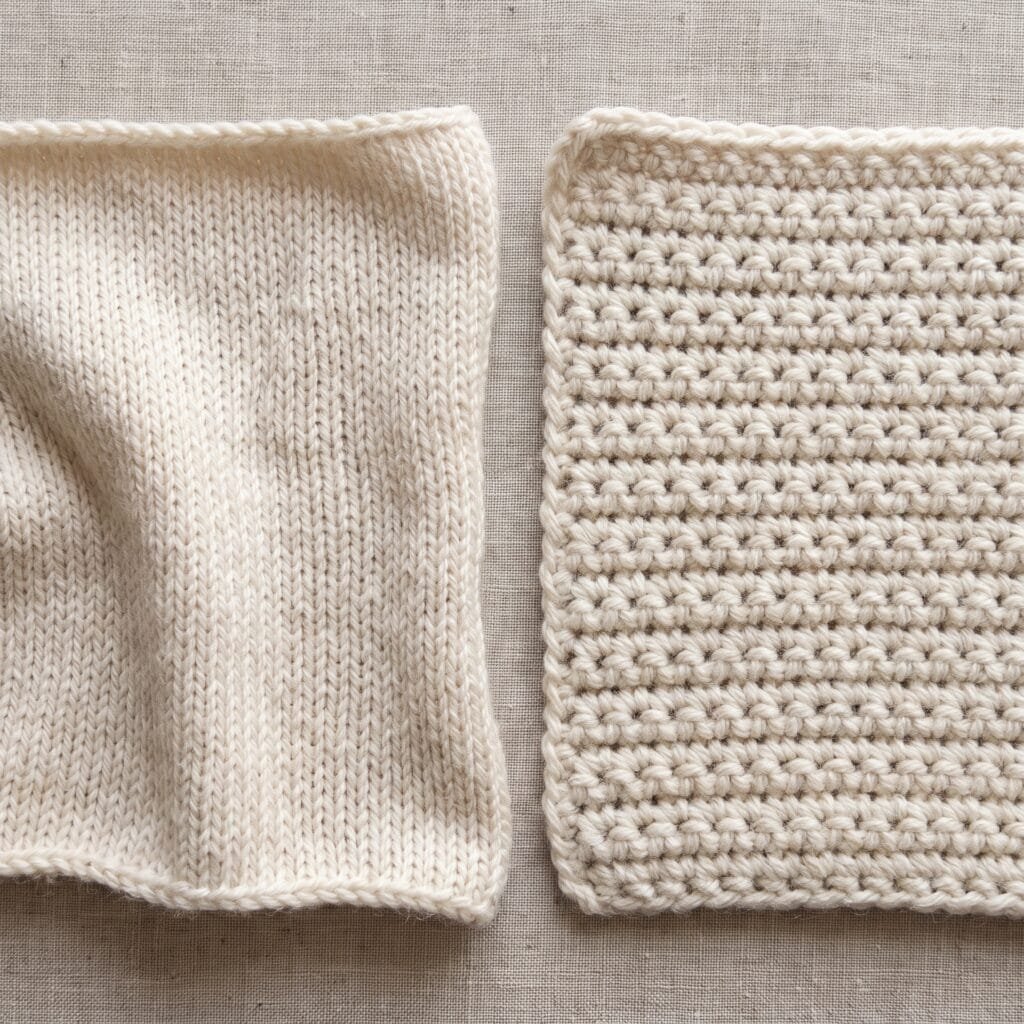
Even at the same yarn weight and a comparable gauge, knit and crochet fabric behave differently once it’s off the tool, and this is honestly one of the bigger practical factors in deciding which craft suits a given project.
Knit fabric tends to have more natural stretch and a smoother, more fluid drape, which is a big part of why it’s been the traditional go-to for sweaters and fitted garments — the fabric moves with a body in a way that suits close-fitting shapes. Crochet fabric, especially in denser stitches like single crochet, tends to hold its shape more rigidly and stretches less, which makes it excellent for structured pieces — blankets that need to lie flat, amigurumi that needs to hold a 3D shape, home decor items that shouldn’t sag.
Neither of these tendencies is absolute. A loose, open crochet stitch pattern can drape beautifully, and a tightly knit stockinette fabric can hold quite a firm shape. But as a general rule of thumb, if I’m making something that needs to closely follow a body’s movement, I lean toward wanting knit fabric’s properties; if I want something with more structural rigidity, crochet’s natural tendency works in my favor rather than against it.
Speed and Yarn Usage: What Actually Tends to Be True
Speed comparisons between the two crafts get thrown around a lot, and I want to be careful here rather than repeating an oversimplified claim as settled fact.
For a beginner’s first few projects, crochet usually feels faster, mostly because of the fewer-moving-parts issue already mentioned — less time spent recovering from small mistakes adds up. For an experienced practitioner of either craft working an established project, the actual pace really comes down to stitch complexity and personal proficiency rather than the craft itself having an inherent speed advantage.
Yarn usage is a bit more consistent as a general pattern, even if I don’t have a single precise number I’d want to hand you as verified fact. It’s a commonly cited estimate across the crochet and knitting community, repeated by enough independent sources that I trust it as a reasonable rule of thumb, that crochet tends to use noticeably more yarn than knitting for a comparably sized project — often estimated somewhere in the range of a quarter to a third more. The structural reason makes sense once you think about it: crochet stitches, particularly taller ones like double crochet, generally use more yarn per stitch than the tighter loop structure of a knit stitch. If you’re working from a fixed yarn budget, that’s genuinely worth factoring into which craft — or which specific pattern — you choose.
What Each Craft Genuinely Does Better
I think it’s more useful to talk about relative strengths than to pretend one craft is objectively superior, because in my experience, each one does specific things the other struggles to replicate cleanly.
Crochet excels at dimensional, sculptural work — amigurumi, 3D flowers, anything that needs to hold a specific shape without a lot of blocking or structural support. It’s also, in my opinion, generally faster to correct mistakes in, and it handles thread-weight fine work (doilies, lace edging) in a way that feels more controlled to me than trying to manage the same fineness on two knitting needles.
Knitting excels at smooth, drapey fabric and is genuinely the stronger choice for most fitted garments, socks especially, where the natural stretch of knit fabric does a lot of the fit-forgiveness work for you. Colorwork techniques like fair isle or intarsia also tend to produce a flatter, more refined finished look in knitting than comparable crochet colorwork techniques typically achieve.
Neither of these is a knock on the other craft — they’re just genuinely suited to different outcomes, the same way a chisel and a sander are both legitimate woodworking tools that happen to be good at different things.
Can You Actually Do Both? My Own Experience Switching
I get asked this a lot, usually from someone worried that learning a second craft will somehow confuse or weaken their existing skills. In my own experience, that hasn’t been true at all.
I picked up knitting a few years into being a serious crocheter, mostly out of curiosity after admiring a knit sweater a friend made. The muscle memory genuinely didn’t fight each other the way I half-expected it might — my hands seemed to understand pretty quickly that these were two separate physical vocabularies, not competing versions of the same skill.
What I did notice is that switching between the two mid-session sometimes left me briefly fumbling the first stitch or two, like my hands needed a beat to reset into the other craft’s motion. That faded with more practice doing both regularly, and now I move between them without much friction at all.
If you’re already comfortable in one craft and curious about the other, I wouldn’t hesitate on the grounds of confusing yourself. The bigger obstacle, honestly, is just finding the time to properly learn a second skill from scratch rather than any real risk of your existing skill degrading.
If you do decide crochet is the one you want to start with, my crochet classes guide covers where to actually find good free and paid instruction, whether you learn better from video or in-person teaching.
Portability and Project Logistics
This doesn’t come up in most comparisons, but it’s genuinely affected which craft I reach for on any given day, especially once travel or commuting is involved.
Crochet projects are generally more compact to carry around mid-project. A single hook takes up almost no space, and most crochet work in progress can be rolled or folded without much risk to the stitches. Knitting projects, especially anything on a long straight needle rather than circulars, take up more physical space and carry a real risk of stitches sliding off an unattended needle if the project gets jostled in a bag.
Circular knitting needles solve a lot of this, to be fair, and plenty of knitters exclusively use them for exactly this portability reason. But it’s still an extra consideration a crocheter simply doesn’t have to think about, since there’s no equivalent “stitches falling off the tool” risk to guard against in a bag.
Airport and flight travel is the other place this matters in a very literal sense. Scissors are usually the bigger restriction either way, but I’ve heard from more than one knitter who’s had circular needles questioned at a security checkpoint, whereas a crochet hook rarely draws a second glance. Rules vary by country and airline, so it’s worth checking current guidance rather than assuming, but it’s one more small logistical point in crochet’s favor for travel-heavy periods of life.
A Note for Left-Handed Crafters
Both crafts are entirely learnable left-handed, but the practical path to learning looks a little different for each, and it’s worth knowing that going in rather than assuming both crafts handle this identically.
For crochet, left-handed instruction generally just means mirroring the standard right-handed motion, and there’s a genuinely healthy amount of dedicated left-handed video content out there now, more than there used to be even a decade ago. I’ve recommended left-handed-specific tutorials to left-handed friends and the transition seems to go smoothly.
For knitting, left-handed crafters have a bit more of a choice to make: some learn a fully mirrored left-handed method, while others learn standard right-handed technique but simply hold the needles in whichever hand feels more natural, since a lot of knitting motion is more symmetrical between the hands than people initially expect. I don’t have personal experience teaching left-handed knitting specifically, so I’d point a left-handed beginner toward searching out left-handed-specific tutorials for whichever craft they choose, rather than assuming a standard right-handed video will translate cleanly without any adjustment.
“Crochet is the easier, less serious craft.” This one genuinely bothers me a little, because it undersells how technically demanding advanced crochet — intricate colorwork, complex 3D amigurumi, fine thread lace — actually is. Easier to start, sure. Simpler as a ceiling, absolutely not.
“Knitting always uses less yarn, full stop.” Generally true as a rule of thumb, as covered above, but it depends heavily on stitch choice within each craft. A dense, cabled knit fabric can use plenty of yarn too; an open, lacy crochet shawl can use comparatively little.
“You need completely different yarn for each craft.” Not really — the same yarn works for both in the vast majority of cases. The main exception is very fine crochet thread, which is thin enough that it tends to slip right off standard knitting needles rather than being genuinely incompatible in any deeper sense.
Frequently Asked Questions
If I already crochet, will learning to knit take a long time? It varies, but most people I’ve taught or talked to get a basic knit stitch down within a session or two, with purl following soon after. Getting genuinely comfortable — steady tension, decent speed — takes longer, similar to how crochet itself took real practice beyond just learning the motion.
Is one craft objectively cheaper than the other to get started in? Not meaningfully. A basic hook costs about the same as a basic pair of needles, and yarn prices are identical either way since it’s the same yarn. If anything, crochet’s higher yarn consumption per project could make it marginally more expensive over many projects, though the difference is small enough that I wouldn’t base a decision purely on cost.
Can I use a crochet hook to fix a mistake in my knitting? Yes, and it’s a genuinely common trick — a crochet hook is handy for picking up a dropped knit stitch and working it back up through the rows above it, which is often easier than trying to fix the same mistake purely with knitting needles.
Which craft is better for making gifts quickly? For most gift-giving timelines, crochet tends to win purely on speed for a beginner or intermediate maker, especially for smaller items like hats or amigurumi. An experienced knitter working an established, simple pattern can move plenty fast too, but the learning curve to get there is generally longer.
Wrapping Up
At the end of the day, the knit vs crochet decision comes down less to one craft being definitively better and more to what you actually want to make and how you personally like to work. I’d still nudge a total beginner toward crochet for that faster, more forgiving first experience, but I genuinely don’t think you’re making a wrong choice either way — and there’s nothing stopping you from eventually learning both, the way I did.
If you’ve made the jump between the two crafts yourself, or you’re stuck deciding which to start with, tell me about it in the comments — I love hearing what tips the decision for people. And if this helped you sort out where to start, sharing it or following along for more beginner-focused guides keeps this kind of content coming.