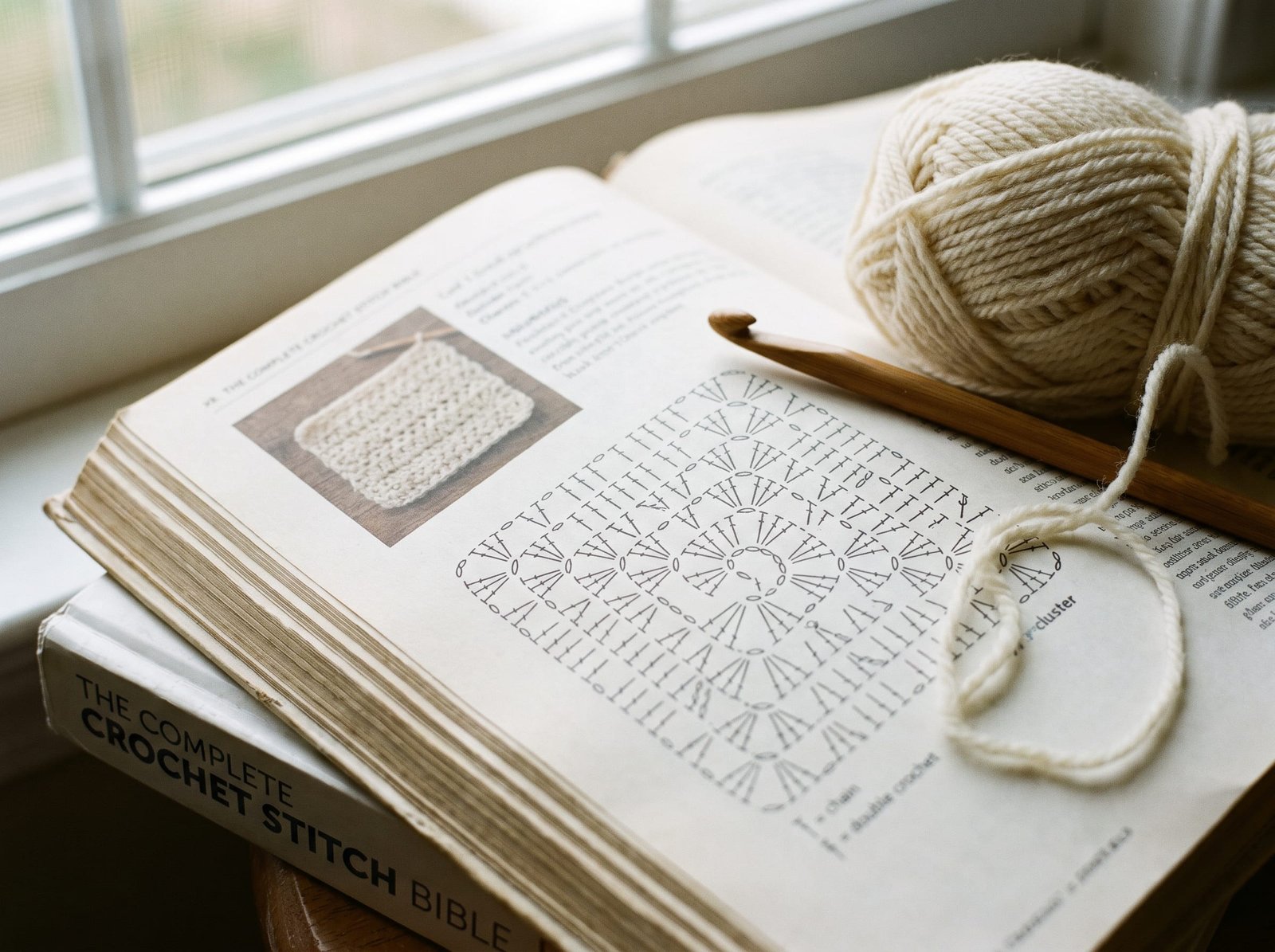
I own more crochet books than I probably need to admit, and a good chunk of them barely got opened past the first project. In this guide I’ll walk through the titles I’d genuinely recommend, where to find real free ones without wading through spam, and a scam pattern I’ve started seeing crop up that’s worth knowing about before you buy anything.
I’ve been building my own crochet library for about a decade now, buying, borrowing, and occasionally regretting purchases along the way, which means I’ve got a pretty clear sense of which books actually earn a permanent spot on the shelf versus which ones look great in a listing photo and disappoint once they arrive. That trial-and-error process is really what this whole guide is distilled from.
What I Actually Look For in a Crochet Book
Before getting into specific titles, it’s worth knowing what separates a book I keep reaching for from one that quietly migrates to a donation pile after a year.
Genuinely tested patterns, not just pretty photos. A book can have gorgeous photography and still contain patterns with stitch counts that don’t add up, or instructions that skip a step the author assumed was obvious. I’ve hit this more than once with newer, less established titles specifically, and it’s a frustrating way to discover a book wasn’t properly tech-edited before publication.
Technique explanations that don’t assume you already know the jargon. A stitch dictionary that just says “work a puff stitch” without ever explaining what a puff stitch actually is isn’t teaching you anything, it’s just testing whether you already knew.
Enough range to still be useful a year later, not just for one season of interest. The books I’ve kept longest are the ones that had something for me as a beginner and still had something to offer once I got more advanced — a stitch dictionary usually ages better this way than a single-skill-level pattern collection.
Crochet Books for Beginners: What I’d Actually Recommend
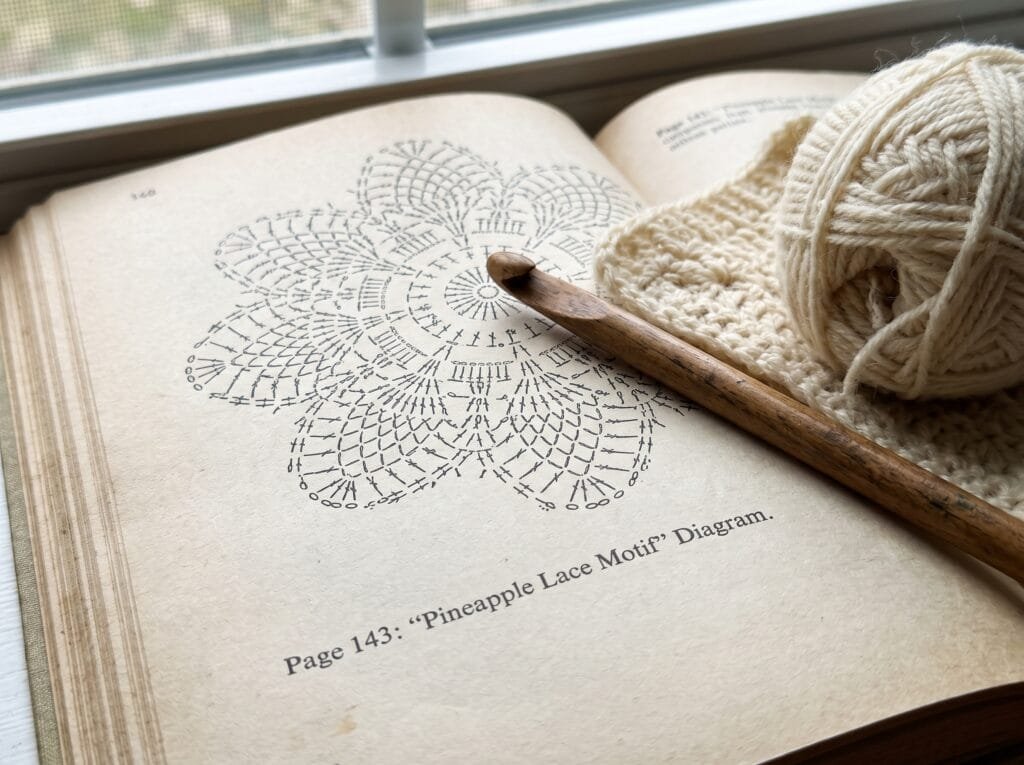
I want to be honest that this is a shorter list than a lot of “best of” roundups you’ll find elsewhere, and that’s deliberate — I’d rather point you toward a small number of books I actually trust than pad this out with titles I haven’t personally verified are worth your money.
The Crochet Answer Book by Edie Eckman. This is genuinely the book I recommend most often to brand-new crocheters. It’s structured as a question-and-answer reference rather than a straight cover-to-cover read, which makes it useful in the exact moment you’re stuck on something specific — you flip to the relevant question rather than hunting through a full chapter. Eckman is a well-established crochet instructor, and it shows in how clearly the explanations are pitched for someone who’s never held a hook before.
Crochet Workshop, also by Edie Eckman. This one goes deeper into structured technique instruction than the Answer Book, and I’d treat it as a natural next step once you’ve got the fundamentals down and want to actually understand why a technique works the way it does, not just how to execute it.
Crochet Stitch Dictionary by Sarah Hazell (Interweave). This isn’t a pattern book, and it’s worth knowing that going in — it’s a reference of individual stitches with clear photos and instructions, meant to be used alongside patterns or your own designs rather than followed start to finish. I still pull mine off the shelf regularly when I want to swap a plain stitch for something more textured in an existing pattern.
I’d resist buying a huge stack of beginner books all at once. One solid reference (the Answer Book, in my opinion) covers most of what a true beginner actually needs, and it’s easy to end up with several overlapping books that all explain the same handful of fundamentals in slightly different words.
Free Crochet Books: Where They Actually Exist
This phrase gets searched constantly, and unfortunately a lot of what turns up is either a thin pattern collection padded out to look like a full book, or a listing that isn’t actually free once you get past the landing page. Here’s where I’ve actually found legitimate, complete books at no cost.
The Antique Pattern Library is genuinely the best resource I’ve found for this. It hosts scanned, public-domain titles spanning roughly the 1840s through the 1950s, all free to download, covering everything from doilies and lace edgings to full afghan patterns. These are real historical publications, not repackaged content, and the collection is large enough that you can spend a genuinely long afternoon just browsing.
Archive.org and Project Gutenberg both host older, public-domain crochet titles as well. The selection leans heavily vintage, similar to the Antique Pattern Library, and some listings are scans of physical books rather than cleanly reformatted text, so expect a bit more visual noise than a modern ebook.
Your local library, through apps like Libby or Hoopla, is worth checking before assuming you have to pay. Most public libraries carry a rotating selection of current titles as ebooks or audiobooks-with-companion-PDFs, and it costs nothing beyond a library card. This is honestly where I’d point someone who wants a genuinely current, modern beginner book without spending money, since the antique libraries mentioned above skew toward vintage stitches and terminology that can be a steeper learning curve for a true beginner.
Ravelry hosts a large number of free individual patterns, though it’s worth being clear that this is patterns rather than full books in the traditional sense — still a legitimate and genuinely free resource if what you’re really after is projects to make rather than a bound reference.
A Warning About AI-Generated Crochet Books
This is a newer problem, and I think it’s worth calling out directly rather than pretending it isn’t happening. Online marketplaces, Amazon in particular, have seen a real influx of low-quality, AI-generated crochet pattern books in the past couple of years — books with plausible-sounding titles and generated cover art, but patterns that were never actually tested by a real crocheter, sometimes with stitch counts that simply don’t work out.
I came across this exact warning from an established crochet blogger while researching this piece, and it matched something I’d started noticing myself while browsing listings — a cluster of suspiciously similar, generic-sounding titles from author names with no other visible published work or online presence. If a “crochet book” listing has no reviews mentioning specific projects actually made from it, vague or stock-photo-style cover art, and an author name you can’t find any other trace of online, that’s worth treating as a red flag rather than an oversight.
The books I’ve recommended above are all from established, verifiable authors with a real teaching or publishing history, which is exactly the kind of track record I’d encourage checking for before buying anything unfamiliar. It takes an extra minute or two to search an author’s name and see whether they have any other visible presence — a website, other titles, social media, teaching credentials — but that small bit of diligence is genuinely worth it compared to ending up with a book full of patterns nobody ever actually tested.
Stitch Dictionaries vs. Pattern Books vs. Technique Books
Part of avoiding a disappointing purchase is understanding that “crochet book” actually covers a few genuinely different categories, and knowing which one you actually want matters more than most buying guides make clear.
Stitch dictionaries are references of individual stitches and stitch patterns, meant to be dipped into rather than read cover to cover. They’re most useful once you already know the fundamentals and want to expand your stitch vocabulary or substitute something more interesting into an existing pattern.
Pattern books are collections of complete, ready-to-make projects — a specific set of instructions for a specific finished item. These are what most people picture when they imagine a “crochet book,” and they’re the right choice if you want to follow along and produce a specific result rather than design your own.
Technique books teach the how and why behind crochet more broadly — reading charts, shaping, finishing methods, troubleshooting — without necessarily being tied to a specific finished project. This is the category both Eckman books mentioned above really fall into, which is part of why I find them so durably useful compared to a book built around one narrow set of patterns.
Knowing which category you actually need before buying saves a lot of the “this isn’t what I expected” disappointment I hear about constantly in crochet groups.
Vintage and Antique Crochet Books: What to Know Before Diving In
If you go the free antique-library route, there’s a genuine learning curve worth knowing about before you get frustrated and assume you’re doing something wrong.
Older titles often use different terminology and abbreviations than modern patterns, and thread weights that were extremely common a century ago (fine crochet cotton, for doilies and lace) are less common on craft store shelves today, so you may need to substitute or specifically seek out thread rather than grabbing typical yarn-aisle yarn. Instructions also tend to be far more terse than modern patterns, often written for an audience that was assumed to already know a lot of foundational technique the book doesn’t bother re-explaining.
None of this makes vintage books unusable, just worth approaching with the right expectations. I’d recommend starting with a smaller, simpler pattern from an antique book — an edging or a small motif rather than a full bedspread — to get a feel for the older instructional style before committing serious time to something large. Once that older style of instruction starts to feel familiar rather than cryptic, working through a bigger vintage project becomes a lot less daunting.
How I Actually Use Mine
I don’t think most of these are meant to be read cover to cover the way you’d read a novel, and treating them that way is part of why some end up gathering dust.
My stitch dictionaries live on a shelf right next to where I actually crochet, and I genuinely only open them when I’m mid-project and want to swap in a different texture. My technique books, the Eckman titles specifically, get pulled out when I’m learning something genuinely new rather than as regular reading — I’ll go months without touching Crochet Workshop and then use it three times in a single week while working through an unfamiliar technique.
Pattern books are the ones I actually do sit down and browse more leisurely, usually when I’m planning a next project and want inspiration rather than solving an immediate problem. If a book you own isn’t earning its shelf space in one of these active ways, it’s worth being honest with yourself about whether you’ll actually reach for it again versus keeping it out of a vague sense that you should.
If books alone aren’t clicking for you and you learn better watching someone demonstrate a technique in real time, my crochet classes guide covers free and paid video instruction options, which might suit your learning style better than a written reference.
Buying a Book as a Gift for a Crocheter
If you’re shopping for someone else rather than yourself, the calculation shifts a little, since you likely don’t know their exact skill level or stitch preferences as precisely as you’d know your own.
A stitch dictionary is actually a pretty safe gift choice for an intermediate or advanced crocheter, since it’s useful regardless of what specific style of project they gravitate toward — unlike a themed pattern book, which risks being full of projects the recipient has zero interest in making. For a true beginner, I’d lean toward a technique-focused reference like the Eckman titles mentioned above rather than a pattern collection, since a beginner usually needs foundational instruction more than a stack of finished-project ideas they can’t execute yet.
If you genuinely don’t know their skill level, it’s worth asking directly rather than guessing, even if it slightly spoils the surprise. I’ve received well-intentioned crochet book gifts pitched at a skill level far above where I actually was at the time, and while I appreciated the thought, the book itself sat unused for a long while until my skills caught up to it. A gift receipt or a quick note that exchanges are welcome goes a long way toward avoiding that same outcome for someone else.
Building a Personal Library Gradually, Rather Than All at Once
I want to push back gently on the instinct to buy a whole shelf of crochet books in one go, especially early on, because I did exactly that and regretted a chunk of the purchases.
My own collection grew slowly and, in hindsight, much more usefully, by buying a new book only once I’d genuinely run into a gap my existing books didn’t cover — wanting deeper technique instruction on a specific method, or realizing I kept improvising stitch patterns that a proper dictionary would have made faster to find. That approach meant every book I bought actually got used, rather than a chunk sitting on a shelf as aspirational purchases I never quite got around to opening.
If you’re just starting to build your own collection, I’d genuinely recommend the same patience. One solid beginner reference is enough to start, and the next book you buy should be solving a specific problem your current library doesn’t already handle, not just adding volume for its own sake.
Buying a huge stitch dictionary as your very first book. These are genuinely useful, but they assume foundational knowledge a total beginner doesn’t have yet. Start with a technique-focused beginner book first, then add a stitch dictionary once the basics are comfortable.
Assuming a big page count means better value. A padded, sparse book with huge margins and one pattern per ten pages can have a smaller page count’s worth of actual useful content despite looking substantial on a shelf. Sample pages or a preview, when available, tell you more than page count alone.
Not checking whether a “free” ebook is actually complete. Some free listings are excerpts or a single chapter from a larger paid book, not the full text. It’s worth reading the actual product description carefully rather than assuming “free” automatically means “complete.”
Frequently Asked Questions
Are older crochet books outdated, or is the information still accurate? The core technique information is generally still completely valid — a double crochet stitch works the same way it did seventy years ago. What changes more is terminology, common yarn availability, and stylistic trends, none of which make the fundamental instruction wrong, just occasionally a little dated in presentation.
Is it worth buying a physical book instead of an ebook version? That really comes down to personal preference and how you like to reference material mid-project. I personally prefer physical books for anything I expect to flip through repeatedly, since it’s faster than navigating a PDF or e-reader app with sticky, yarn-covered hands, but plenty of crocheters happily work entirely from tablets or phones propped up nearby.
Do I need different books for crochet versus knitting, or is there overlap? You’ll want separate technique books, since the actual stitch mechanics are different enough that a knitting-specific book won’t teach you crochet fundamentals and vice versa. Some general craft or yarn-focused books do cover both, but dedicated single-craft books tend to go deeper on either one.
How do I know if a crochet book is actually good before buying it, especially online? Look for reviews that mention specific projects the reviewer actually made from the book, not just generic praise. An author with an established teaching background, a website, or other published work is also a reasonable signal of legitimacy, especially given how many low-effort or AI-generated books have started appearing in this space recently.
Is it worth buying the same book in both print and digital format? Not usually, in my experience, unless you specifically split your crocheting between home and travel and want a lightweight digital copy for one setting and a physical copy for the other. For most people, picking one format and sticking with it is plenty — the content doesn’t change between print and digital, so the decision really just comes down to how you personally prefer to reference material.
Wrapping Up
A good handful of genuinely useful crochet books will outlast dozens of impulse purchases, and I’d rather you own three books you actually reach for than a shelf full of ones you bought on a whim and never opened again. Start with a solid technique reference, add a stitch dictionary once you’re past the basics, and don’t overlook the genuinely free options if budget is a factor — just go in knowing what you’re getting with vintage material specifically. Building a library this way, one deliberate purchase at a time, has served me a lot better over the years than any impulse haul ever did.
If you’ve got a crochet book that’s earned a permanent spot on your own shelf, tell me about it in the comments — I’m always looking to add to my collection. And if this saved you from a disappointing purchase, sharing it or following along for more resource guides keeps this kind of content coming.