The first pattern I ever tried to follow told me to “sc 6, hdc 2tog, ch 1, sl st in next st,” and I genuinely put the hook down and closed the tab. Crochet acronyms look like a foreign alphabet the first time you meet them, and nobody hands you a decoder ring with your first skein of yarn. This guide is the decoder ring I wish I’d had — every common abbreviation, what it actually means at the hook, and the handful that trip people up even after years of crocheting.
I’m not going to just dump a list on you and call it done. I’ll walk through why patterns are written this way at all, the acronyms that matter most when you’re starting out, the US-versus-UK trap that catches even experienced crocheters off guard, and a French-English reference for anyone reading a pattern in a second language.
What Crochet Acronyms Actually Are (and Why Patterns Use Them)
Crochet acronyms are the shorthand designers use so a pattern doesn’t read like a paragraph of instructions for every single stitch. Instead of writing “work one single crochet stitch into the next stitch” fifty times in a row, a pattern just says “sc” and trusts you to know what that means.
It’s genuinely a space-saving convention more than anything mysterious. A pattern for a full sweater written out in plain English, stitch by stitch, would run for dozens of pages instead of two or three. Once the abbreviations click, a pattern stops looking like code and starts reading almost like sheet music — a compact set of symbols standing in for a physical motion your hands already know.
The tricky part is that almost no pattern explains every acronym it uses, on the assumption you’ve already learned the common ones somewhere else. That assumption is fair for someone who’s been crocheting for years. It’s rough for someone on their first project, which is exactly the gap this guide is meant to close.
The Basic Stitch Acronyms Everyone Should Know First
Before you touch anything fancier, these are the stitches that show up in almost every pattern you’ll ever read, listed in the order most people naturally learn them.
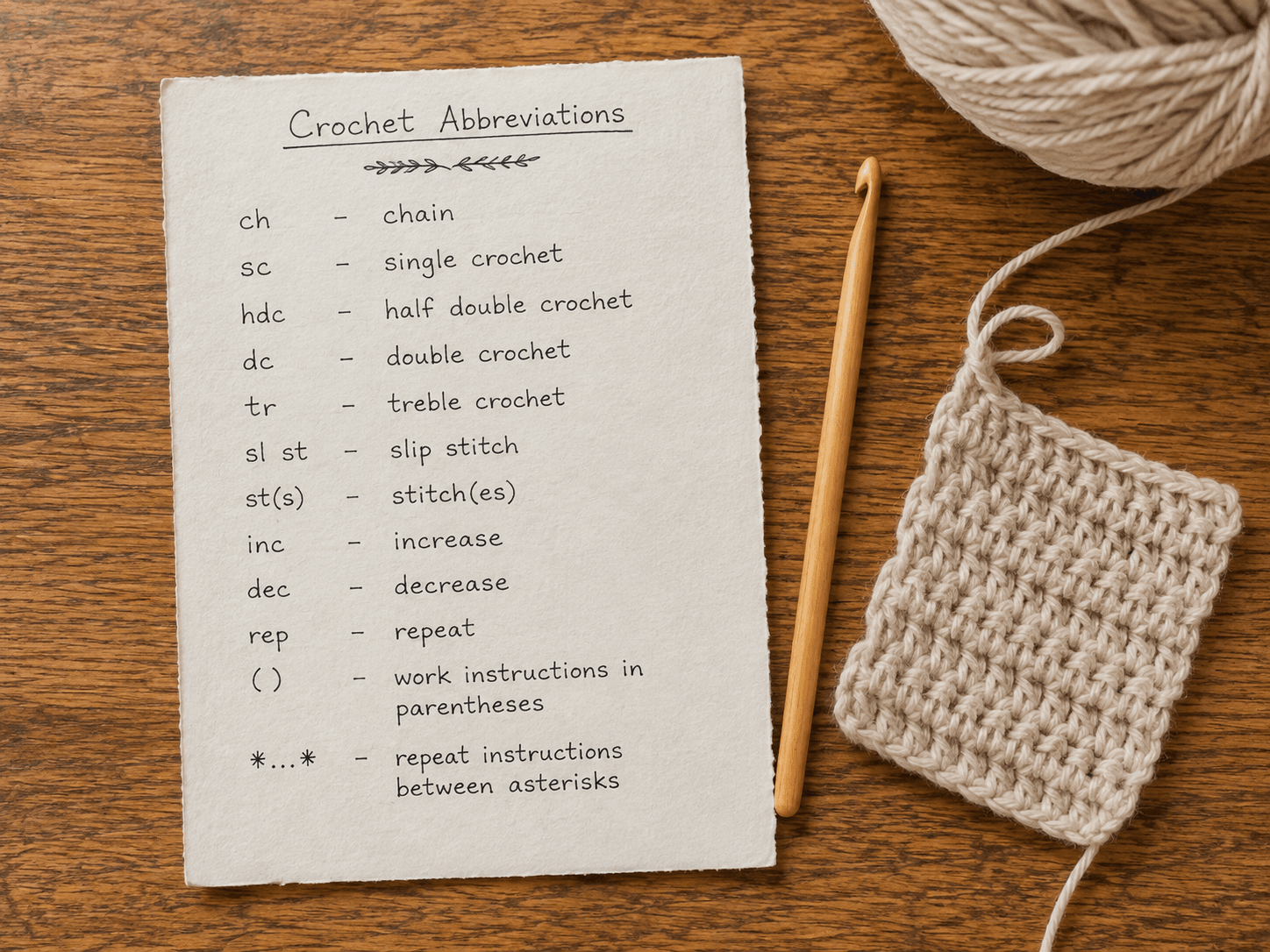
ch — chain. The foundation loop-through-loop stitch nearly every project starts with. If a pattern opens with “ch 20,” you’re making a starting chain of 20 loops before anything else happens.
sl st — slip stitch. A low, flat stitch mostly used to move across existing stitches without adding height, or to close a round. It’s rarely a stitch a whole project is made of; it’s more of a connector.
sc — single crochet. The shortest “real” stitch in US terminology, and usually the first one new crocheters practice. It creates a dense, tight fabric, which is part of why it’s so common in amigurumi.
hdc crochet — half double crochet. This one sits in the size gap between single and double crochet: taller than sc, shorter and denser than dc. If a pattern calls for a fabric that’s a bit more textured than single crochet but still fairly firm, hdc crochet is usually the stitch doing that job. I reach for it constantly on hats and cowls, where I want more drape than sc gives but not the slightly looser look of dc.
dc — double crochet. A taller stitch that works up faster than sc because each stitch covers more height per motion. Most blankets and garments you’ve seen with an open, airy look were probably worked mostly in dc.
tr — treble (or triple) crochet. Taller again than dc, used less often on its own but common in lacy or openwork patterns where height and gaps matter more than density.
Sl Abbreviation in Crochet: The One Beginners Actually Mix Up
The sl abbreviation crochet patterns use most often — sl st for slip stitch — gets confused with something else surprisingly often: the slip knot you tie at the very start of a project to get your first loop onto the hook.
A slip knot is a one-time setup move. You make it once, at the beginning, before your first chain stitch even exists. A slip stitch (sl st) is a stitch you’ll use repeatedly throughout a pattern, to join rounds, move across stitches invisibly, or finish an edge without adding bulk.
I mixed these two up constantly in my first month of crocheting, mostly because “slip” shows up in both names and nothing about the abbreviation tells you which one a pattern means unless you already know the difference. If a pattern says “make a slip knot” as a setup instruction, that’s the one-time starting loop. If it says “sl st in next st” mid-pattern, that’s the connecting stitch, and you’ll do it again and again as the project calls for it.
US vs UK Crochet Acronyms: The Trap That Gets Everyone Eventually
This is, without exaggeration, the single most common source of confusion I see in crochet groups and comment sections, and it catches people who’ve been crocheting for years, not just beginners.
The US and UK systems use the same letters for completely different stitches. A US “dc” (double crochet) is the same physical stitch as a UK “tr” (treble). Meanwhile, a UK “dc” refers to what Americans call “sc” (single crochet). Same abbreviation, genuinely different stitch, depending entirely on which country’s pattern you’re holding.
I learned this the hard way on a British designer’s shawl pattern years ago, working every “dc” as an American double crochet. The shawl came out noticeably denser and smaller than the photo, and I spent an embarrassing amount of time blaming my gauge before I realized the pattern was written in UK terms the entire time. Most published patterns will state their terminology somewhere in the notes — if yours doesn’t, and the stitch count or fabric looks off partway through, checking whether it’s a US/UK mismatch is worth doing before you assume it’s your tension.
Abréviation Crochet Anglais Français: A Translation Reference
If you learned to crochet in French, or you’re working from a pattern that switches between the two languages, matching up abréviation crochet anglais français terms is its own small skill on top of learning the stitches themselves.
Here’s how the most common ones line up, based on standard French crochet terminology:
- ml (maille en l’air) corresponds to ch (chain)
- mc (maille coulée) corresponds to sl st (slip stitch)
- ms (maille serrée) corresponds to sc (single crochet) in US terms
- db / demi-bride (demi-br) corresponds to hdc (half double crochet)
- br (bride) corresponds to dc (double crochet)
- db / double bride corresponds to tr (treble crochet)
- aug (augmentation) corresponds to inc (increase)
- dim (diminution) corresponds to dec (decrease)
- rab. / arrêter le fil corresponds to FO (fasten off)
Notice that “db” shows up twice in French — once as a shorthand for “demi-bride” and again for “double bride,” depending on the source. That overlap trips up a lot of bilingual crocheters, myself included, the first time they meet it. When it’s ambiguous, the surrounding pattern context (whether it’s building a shorter or taller stitch at that point) is usually the fastest way to tell which one is actually meant.
One more wrinkle worth knowing: French patterns almost universally follow what’s closest to the UK stitch heights rather than the US ones — a French “bride” lines up with the taller UK “double crochet,” not the shorter US “single crochet,” even though the English words look similar. If you’re translating a French pattern into English for your own notes, it’s worth double-checking which English system (US or UK) you’re converting into, since picking the wrong one changes your fabric height across an entire project.
Amigurumi and Shaping Acronyms You’ll Meet Constantly
Once you move past basic stitches, a second layer of acronyms shows up specifically around shaping and finishing, especially in amigurumi patterns.
inc — increase. Working two stitches into the same stitch to add width, usually written as “inc” or spelled out as “2 sc in next st.”
dec — decrease. The opposite: combining two stitches into one to reduce width, often written “sc2tog” for a single crochet decrease specifically.
MR / magic ring. An adjustable starting loop used instead of a chain for working in the round, popular in amigurumi because it closes tightly with no visible hole at the center.
BLO / FLO — back loop only / front loop only. Instructions to work into just one loop of a stitch instead of both, which creates a ribbed or textured line in the fabric.
st(s) — stitch(es). About as basic as it gets, but worth mentioning because it shows up constantly inside other instructions, like “2 sc in next st” or “sc in each st around.”
rep — repeat. Signals that a sequence should be worked again, often paired with asterisks marking exactly which part repeats.
FO — fasten off. The step that secures your last loop so the piece won’t unravel. If you want the full walkthrough on doing this properly, including the invisible version amigurumi makers rely on, I’ve got a whole guide on how to tie off crochet that goes into more depth than I can fit here.
Textured and Special Stitch Acronyms
Beyond the basic six stitches, a second tier of acronyms shows up specifically in textured patterns — cables, popcorn stitches, anything with visual bumps or clusters.
bo / bobble. A cluster of incomplete stitches worked into the same spot and closed together at the top, creating a raised bump. Different designers abbreviate this slightly differently, so it’s worth checking the pattern’s own key rather than assuming.
pc / popcorn. Similar in spirit to a bobble but usually made from complete stitches folded over on themselves, giving a firmer, more defined bump than a bobble typically produces.
cl / cluster. A general term for several stitches worked together and joined at the top, used as a building block in a lot of shell and fan stitch patterns rather than as a stitch on its own.
pf / puff. A softer, rounder raised stitch made from several loops pulled through together, common in puff-stitch blankets and textured scarves.
None of these show up nearly as often as sc, dc, or hdc, and you genuinely don’t need to memorize them ahead of time. I’d never used a bobble stitch acronym until my third year of crocheting, when a specific blanket pattern called for it — and the pattern itself defined it clearly enough that I didn’t need to hunt down an outside reference at all.
Punctuation That Pairs With Crochet Acronyms
Acronyms aren’t the only shorthand patterns lean on. Asterisks, parentheses, and brackets carry just as much meaning, and misreading them causes at least as many mistakes as misreading a stitch abbreviation.
Asterisks (…) mark a section meant to be repeated. “sc in next 3 sts, inc rep around” means you work everything between the asterisks over and over until the round is complete, not just once.
Parentheses (…) usually group a sequence that happens together at a single point, like “(2 dc, ch 1, 2 dc) in next st,” meaning all of that goes into one single stitch rather than spreading across several.
Brackets […] at the end of a row or round almost always indicate the total stitch count you should have once you finish, which is one of the most useful checkpoints a pattern gives you. If your count doesn’t match what’s in the brackets, it’s worth stopping and recounting before you move on, rather than continuing and hoping it evens out later.
I ignored stitch-count brackets entirely on an early project, assuming they were just for reference, and didn’t notice I’d dropped a stitch four rows earlier until the whole shape had visibly skewed. Treating that bracketed number as an actual checkpoint, not a suggestion, would have caught the mistake within a single row.
A Few More US/UK Pairs Worth Knowing
Beyond the sc/dc swap that trips up most people, a few other pairs are worth having in your back pocket, especially if you crochet from both American and British designers.
- US dtr (double treble) matches UK ttr (triple treble)
- US ttr (triple treble) matches UK qtr (quadruple treble)
- US sk (skip) is used the same way in both systems, so it’s one of the few that doesn’t shift
- US inc / dec also stay consistent across both systems, since increasing and decreasing aren’t tied to a specific stitch name the way sc and dc are
These taller stitches show up far less often than sc, hdc, or dc, so I wouldn’t lose sleep memorizing them upfront. But if you ever hit “ttr” in a pattern and it looks unfamiliar, it’s worth a quick check of which country’s terminology you’re reading before assuming it’s a typo or an unusually advanced stitch you’ve simply never encountered.
How I Actually Got These to Stick
Flashcards felt silly to me at first, so for a long time I just kept a printed cheat sheet taped inside my project bag and looked things up mid-row whenever I forgot. That worked fine, but it wasn’t until I started saying the abbreviations out loud as I worked — actually muttering “single crochet, single crochet, chain one” under my breath — that they properly stuck in a way I didn’t have to look up anymore.
If you’re a visual learner, it might click faster to watch a stitch being made while reading its abbreviation at the same time, rather than memorizing a list in isolation. Whatever method you use, expect the basic six or seven to become automatic within a few projects, even if the rarer ones stay a lookup item for a while longer. That’s completely normal — I still double-check some of the less common shaping abbreviations myself.
A friend who taught herself to crochet from video tutorials told me she never consciously memorized anything at all — the abbreviations just accumulated naturally because she heard the instructor say the full stitch name out loud every time the abbreviation appeared on screen. There’s no one right path here; the goal is just repeated exposure in whatever form actually holds your attention long enough to sink in.
Common Mistakes When Reading Crochet Acronyms
Assuming every pattern uses US terms by default. Most do, but not all, and the two systems genuinely mean different stitches for the same letters. Check the pattern notes before you start.
Confusing a slip knot with a slip stitch. As covered above, one is a one-time setup, the other is a repeated stitch throughout the pattern.
Skipping the abbreviation key at the top of a pattern. Designers sometimes use a nonstandard shorthand for a special stitch they invented, and it’ll only be defined once, right at the start. Skipping past it means you’ll hit an unfamiliar acronym later with no explanation in sight.
Misreading “sc2tog” as two separate instructions. It’s one combined instruction — a single decrease made from two stitches — not “single crochet, then two together” as two separate steps.
Guessing at an unfamiliar acronym instead of looking it up. I’ve guessed wrong more than once and had to frog several rows because I assumed a stitch I didn’t recognize was similar to one I did. A quick search almost always beats a guess.
A Few Real Reader Questions
Is there one universal list of crochet acronyms, or does every designer make up their own? There’s a widely used standard set — sc, dc, hdc, tr, ch, sl st, inc, dec, and so on — that the vast majority of published patterns follow. Individual designers sometimes add their own shorthand for a specialty stitch they’ve created, but they’ll almost always define it at the start of that specific pattern.
Why do amigurumi patterns seem to use more acronyms than blanket patterns? Amigurumi relies heavily on precise shaping — increases, decreases, working in the round — so those specific acronyms (inc, dec, MR, BLO/FLO) come up far more often than they would in a straightforward blanket worked mostly in one repeated stitch.
Do I need to memorize every acronym before I start my first project? Not even close. Learn ch, sl st, sc, hdc, and dc first, since those cover the overwhelming majority of beginner patterns. Everything else you can look up as you meet it, and it’ll start sticking naturally after a few projects.
I’m working from a pattern that mixes English and French terms. Is that normal? It happens more than you’d expect, especially with independently published patterns from bilingual designers or older patterns that were translated by hand rather than professionally. If a term looks unfamiliar in either language, checking a French-English abbreviation reference before assuming it’s a typo will save you a lot of frustration.
What’s the fastest way to tell if a pattern is US or UK terminology without reading the whole notes section? Scan the pattern for “sc.” If it appears anywhere, the pattern is almost certainly using US terms, since UK patterns don’t have a stitch called single crochet at all — their shortest stitch after slip stitch is double crochet. It’s a quick, reliable check when a pattern’s notes section doesn’t spell it out directly.
Bringing It All Together
Once the core crochet acronyms stop needing a lookup — ch, sl st, sc, hdc, dc, and a handful of shaping terms — a pattern really does start reading more like a familiar recipe than a puzzle, and that shift genuinely does happen faster than most beginners expect. Keep this guide bookmarked for the terms that don’t stick right away, especially the US/UK differences and the French correspondences, since those are the ones that trip up even people who’ve been crocheting for years. The Craft Yarn Council’s master abbreviations list is worth bookmarking too, since it covers the full standardized set designers draw from, including the less common ones I haven’t gone into here.
If there’s an acronym you’ve run into that still doesn’t make sense, drop it in the comments — chances are someone else has hit the exact same wall and would appreciate the answer too. And if this saved you from closing the tab the way I almost did on my first pattern, feel free to pass it along to someone just starting out.