The treble crochet stitch is one of the tallest stitches in regular use, and it’s also one of the most commonly mixed up between US and UK pattern terminology — a confusion that can genuinely ruin a project if it goes unnoticed. This guide walks through exactly how to work the stitch, where it’s useful, and — importantly — clears up the terminology differences that trip up even experienced crocheters when a pattern doesn’t specify which system it’s using.
Unlike a specific project pattern, everything in this guide is standardized technique — the mechanics of a treble crochet stitch don’t vary by designer the way a garment’s fit or a toy’s proportions might, so what follows is accurate regardless of who’s teaching it.
What Makes Treble Crochet Different From Other Basic Stitches
Crochet stitches are essentially defined by how many times you wrap the yarn over the hook before you start pulling through loops, which directly controls how tall the finished stitch is. A single crochet has no extra yarn over before inserting the hook, and produces a short, dense stitch. A half double crochet adds one yarn over and a different loop-pulling sequence for a slightly taller stitch. A double crochet (in US terms) adds one yarn over before inserting the hook, producing a noticeably taller stitch that works up fabric more quickly.
A treble crochet takes that progression one step further: two yarn overs before inserting the hook, producing a stitch taller again than a double crochet — roughly half again as tall, in practical terms. This extra height is exactly why treble crochet shows up so often in openwork, lace, and fast-growing projects: taller stitches cover more vertical distance per row, and the added height creates more visual space between stitches, which reads as airy and open rather than dense.
How to Work a Treble Crochet Stitch, Step by Step
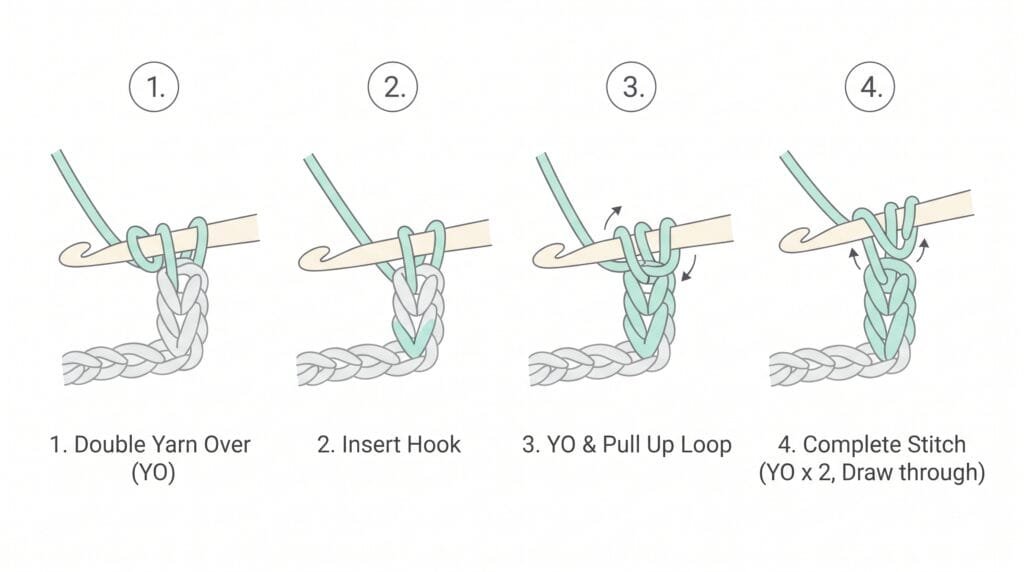
This assumes US terminology, which is what the rest of this guide uses unless specifically noted otherwise — the terminology section further down explains why that distinction matters.
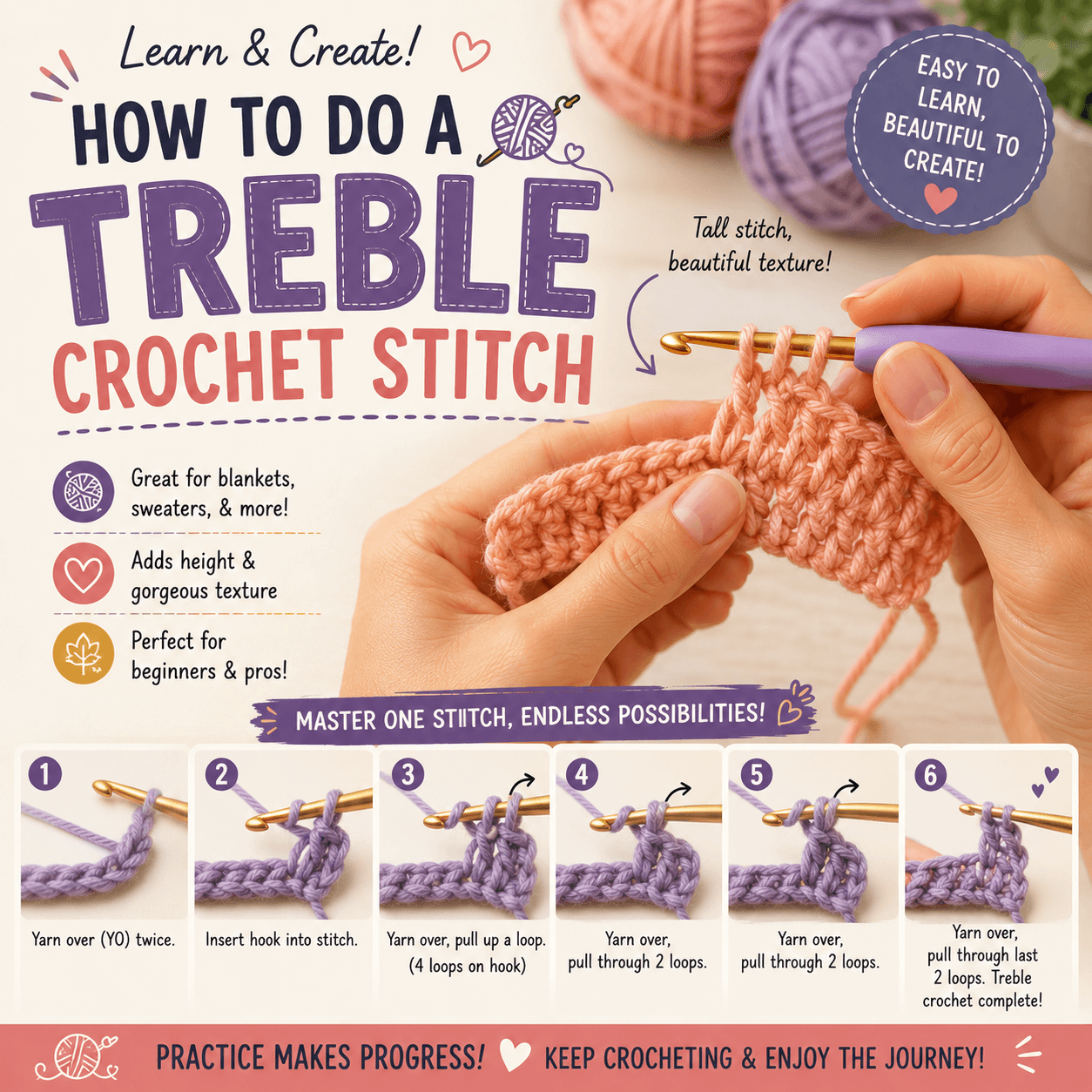
Step one: Yarn over twice before doing anything else. This is the detail most beginners get wrong when first learning treble crochet — it’s easy to yarn over only once out of habit from double crochet, which throws off the entire stitch.
Step two: Insert your hook into the stitch (or space) you’re working into.
Step three: Yarn over once more and pull up a loop. At this point you should have four loops sitting on your hook: the two from your original double yarn-over, plus the loop you just pulled through.
Step four: Yarn over and pull through the first two loops on your hook. You’ll now have three loops remaining.
Step five: Yarn over again and pull through two more loops. Two loops remain.
Step six: Yarn over one final time and pull through the last two loops. One loop remains on your hook, and the stitch is complete.
The stitch essentially “unwinds” the extra yarn over in stages — pulling through two loops at a time, three separate times, rather than all at once. This staged pull-through is what all the taller stitches (treble, double treble, and beyond) have in common; they just start with more yarn overs and therefore need more stages to work through.
Turning Chain Height for Treble Crochet Rows
Because a treble crochet stitch is tall, the turning chain at the start of a new row needs to be tall enough to substitute for that first stitch’s height, or the edge of your work will pull in unevenly. In US terms, a treble crochet row typically starts with a chain of four (counted as the first stitch of the row), compared to a chain of three for double crochet or a chain of two for half double crochet. Skipping this height adjustment — using the same turning chain height out of habit regardless of stitch — is one of the most common causes of a wavy, uneven edge on a treble crochet project.
US vs UK Terminology: Where “Treble” Gets Genuinely Confusing
This is worth its own dedicated section, because it’s a real, well-documented source of project-ruining mistakes, not just a minor labeling quirk.
US and UK crochet terminology assign the same stitch names to different actual stitches, offset by one step along the height progression. According to the Craft Yarn Council’s official terminology comparison, which documents the standardized differences between US, UK, and Canadian crochet terms, a US double crochet is the same stitch as a UK treble crochet — meaning the word “treble” itself refers to a taller stitch in UK terms than what a US crocheter would call “treble.”
Laid out directly:
A US single crochet matches a UK double crochet. A US half double crochet matches a UK half treble crochet. A US double crochet matches a UK treble crochet. A US treble crochet — the stitch this guide has been walking through — matches a UK double treble crochet. And a US double treble crochet matches a UK triple treble crochet.
The practical danger here is real: if you follow a UK pattern while assuming US terms, every stitch you work will be one full step taller than the pattern intended, and the finished piece will come out noticeably larger and more open than designed — sometimes not obvious until the piece is significantly underway. Checking which terminology system a pattern uses before starting, not partway through when the proportions start looking off, is the only reliable way to avoid this.
Half Treble Crochet Stitch: A UK Term Worth Knowing
This phrase specifically only exists in UK terminology — there’s no stitch called “half treble” in the US naming system. A UK half treble crochet is the exact same stitch as a US half double crochet, just under a different name.
For reference, here’s how that stitch works, regardless of which name you use for it: yarn over once, insert the hook into the stitch, yarn over and pull up a loop (three loops now on the hook), then yarn over one final time and pull through all three loops in a single motion, rather than the staged two-at-a-time pull-through used for taller stitches like treble crochet. This single-motion pull-through is actually what makes this stitch shorter than a double/treble crochet — there’s no intermediate stage where extra height gets built in.
If you’ve encountered the term “half treble crochet stitch” in a pattern or a search and weren’t sure whether it was a variation on treble crochet specifically, this is the clarification: it isn’t a shorter version of the treble stitch covered above, despite sharing the word “treble.” It’s simply the UK name for a different, shorter stitch that US crocheters know as half double crochet.
Double Treble Crochet: Also Worth Clarifying Carefully
Similar to “half treble,” this phrase means genuinely different things depending on which terminology system is in use, and it’s worth being explicit about both meanings rather than assuming one.
In US terms, a double treble crochet is a taller stitch than the treble crochet covered at the top of this guide — worked with three yarn overs before inserting the hook, rather than two, and pulled through in four stages instead of three (yarn over and pull through two loops, repeated four times total, rather than three). This produces a noticeably tall, open stitch, most often seen in lace-weight or very openwork designs where dramatic height and spacing are the goal.
In UK terms, “double treble” refers to the same stitch US crocheters call treble crochet — the two-yarn-over stitch this entire guide has been focused on. This is the direct consequence of the terminology offset explained in the section above.
Because this guide follows US terminology throughout, “double treble crochet” here refers to the taller, three-yarn-over stitch. If you’ve found this phrase in a UK-terminology pattern, though, it’s worth mentally substituting the shorter two-yarn-over treble stitch instead, to avoid ending up with a much taller, more open fabric than the pattern actually intended.
A Simple Treble Crochet Stitch Approach for Practicing
If the staged pull-through process feels awkward at first — which is completely normal, since it’s a more involved motion than single or half double crochet — practicing on a plain swatch before attempting it inside an actual project removes the pressure of also managing shaping or stitch counts at the same time.
A simple treble crochet stitch practice swatch: chain a comfortable number of stitches (twenty is plenty), work a turning chain of four, then work a full row of treble crochet across, focusing purely on the yarn-over count and the staged pull-through rather than on speed. Repeating this for a few rows, without worrying about a finished project at the end, is often enough to make the motion feel automatic rather than something you have to consciously count through every single stitch.
Where Treble Crochet Fits Into Actual Projects
Treble crochet earns its place in a lot of designs specifically because of the height and openness discussed earlier, and it shows up in more places on this site than you might expect once you know to look for it.
The shell and cluster rounds discussed in our mandala crochet pattern guide frequently use treble crochet rather than a shorter stitch specifically because the extra height gives the raised, dimensional look those rounds are going for — a shell worked in double crochet reads as noticeably flatter and less dramatic than the same shell worked in treble.
Similarly, the open, airy stitch category discussed in our crochet sweater pattern guide — the drapey, lightweight garment fabric that uses less yarn than a dense double crochet body — often relies on treble crochet mesh or v-stitch patterns to get that open, flowing quality without switching to a different yarn weight.
Where Treble Crochet Sits in the Full Stitch Height Family
Understanding treble crochet’s place relative to every other basic stitch height makes it much easier to predict how a pattern will behave before you’ve worked a single row.
Slip stitch has essentially no height at all — it’s used for joining and moving across existing stitches, not for building new fabric height. Single crochet is the shortest true fabric-building stitch, worked with no yarn over before inserting the hook, producing a dense, tight fabric. Half double crochet sits between single and double crochet in height, with one yarn over before inserting the hook and a single-motion three-loop pull-through, giving a fabric that’s fuller than single crochet but still fairly dense. Double crochet, with one yarn over before inserting the hook and a two-stage pull-through, roughly doubles single crochet’s height and is probably the most commonly used “default” stitch across general patterns. Treble crochet, covered throughout this guide, adds a second yarn over and a three-stage pull-through, again increasing height meaningfully over double crochet. Double treble crochet continues the same progression with a third yarn over and a four-stage pull-through, producing a very tall, open stitch mostly reserved for dramatic lace or extremely fast-growing projects.
Each step up this ladder roughly adds another quarter to a third more height per stitch (the exact amount varies by yarn and tension), while simultaneously making the fabric more open, since the same amount of yarn is being stretched to cover more vertical space rather than packed densely. This tradeoff — height and speed against density and warmth — is really the core design decision behind choosing any stitch height for a project, treble crochet included.
When Treble Crochet Isn’t the Right Choice
Given how often treble crochet gets recommended for speed and openness, it’s worth being equally direct about when it’s the wrong tool.
Anything meant to be warm and windproof — a winter hat, mittens, a blanket meant for genuine insulation — generally wants a denser stitch than treble crochet naturally produces. The same openness that makes treble crochet appealing for lace works against it here, since gaps between stitches let air move through the fabric rather than trapping warmth.
Amigurumi and other stuffed projects essentially never use treble crochet, for a related reason — the open structure lets stuffing show through the gaps, which is exactly the problem our crochet cow pattern guide addresses by recommending a smaller hook and dense single crochet fabric instead.
Projects requiring precise, structured shaping — a fitted garment section, a small detailed motif — can be harder to control in treble crochet simply because each stitch covers more ground, giving you less fine-grained control over gradual shaping changes than a shorter stitch would allow.
Holding Tension Through the Longer Stitch
Because treble crochet involves more motion per stitch than shorter stitches, tension consistency can drift more easily, particularly for newer crocheters.
Keeping the working yarn tensioned consistently through your non-hook hand — rather than letting it go slack between the multiple yarn overs a single treble crochet stitch requires — helps prevent the loose, uneven look that can result from momentarily losing tension partway through a stitch. It’s also worth periodically checking that all the stitches across a row are landing at a similar height; because treble crochet is tall enough that small inconsistencies are more visually obvious than they’d be in single crochet, catching a drift in height early, rather than after several rows, makes correcting it far less disruptive.
Common Treble Crochet Problems and Their Causes
Rows come out uneven in height. This is almost always a turning chain problem — using a chain height meant for a shorter stitch (like the standard three-chain used for double crochet) doesn’t provide enough height to match an actual treble crochet stitch, so the row edge pulls in and looks uneven compared to the rest of the row.
A hole appears at the start or end of rows. This often happens when the turning chain isn’t being treated consistently — either always counted as the first stitch of the row or never counted as one, rather than switching back and forth, which leaves either a gap or a doubled-up stitch at the row edge.
Losing count partway through the stitch. Because treble crochet involves more stages than shorter stitches, it’s easy to lose track of whether you’re on the second or third pull-through, especially early on. Counting the loops remaining on your hook after each pull-through — three, then two, then one — rather than trying to count the pull-throughs themselves, tends to be a more reliable check.
The fabric feels too open or floppy for the intended project. This isn’t necessarily a mistake — it’s often just a mismatch between treble crochet’s naturally open structure and a project that actually wanted a denser fabric. If a pattern specifically calls for treble crochet and the result still feels too open, double-checking gauge and hook size is worth doing before assuming the stitch itself is wrong for the project.
Common Questions About Treble Crochet
Is treble crochet harder to learn than double crochet? Not conceptually — it’s the same basic idea of yarn over, insert, and pull through in stages, just with one extra yarn over and one extra stage. Most people who are comfortable with double crochet pick up treble crochet within a swatch or two of practice.
Why do some patterns use “tr” and others use “dtr” for what looks like the same tall stitch? This is almost always the US/UK terminology difference discussed above, rather than an inconsistency within a single pattern. Checking which terminology system a specific pattern or designer uses, usually noted near the beginning, resolves this quickly.
Can I substitute treble crochet for double crochet in a pattern to make it faster? Not without other adjustments — treble crochet’s extra height and openness change both the finished size and the fabric’s drape, so a straight swap will alter the project’s proportions and gauge significantly, not just its speed. Substituting stitch heights generally requires recalculating the pattern’s numbers rather than a direct one-for-one swap.
Does the “half” in half treble crochet mean it’s worked halfway through the treble crochet steps? Not exactly — as covered above, half treble crochet (UK terminology) is a completely different, shorter stitch equivalent to a US half double crochet, not a partially completed treble crochet. The naming can suggest that relationship, but the actual stitch mechanics are distinct.
Is it normal for treble crochet to feel slower to work than double crochet, even once I know the motion? Yes — each treble crochet stitch genuinely involves more individual motions (two yarn overs going in, three separate pull-through stages) than a double crochet’s single yarn over and two-stage pull-through. The stitch grows fabric faster in terms of height per row, but the extra height doesn’t necessarily mean faster in terms of raw stitch-by-stitch speed, especially while the motion still feels new.
Bringing It Together
The treble crochet stitch itself is a straightforward extension of the same yarn-over-and-pull-through logic behind every basic crochet stitch — what actually trips people up is almost never the stitch mechanics themselves, but the terminology differences between US and UK patterns that can make the exact same word mean two different heights of stitch. Knowing both the mechanics and the terminology map covered in this guide should cover both sides of that confusion.
If you’re practicing treble crochet or working through a pattern that uses it, we’d love to hear how it’s going — share a comment with what you’re making, and follow along for more stitch guides like this one.