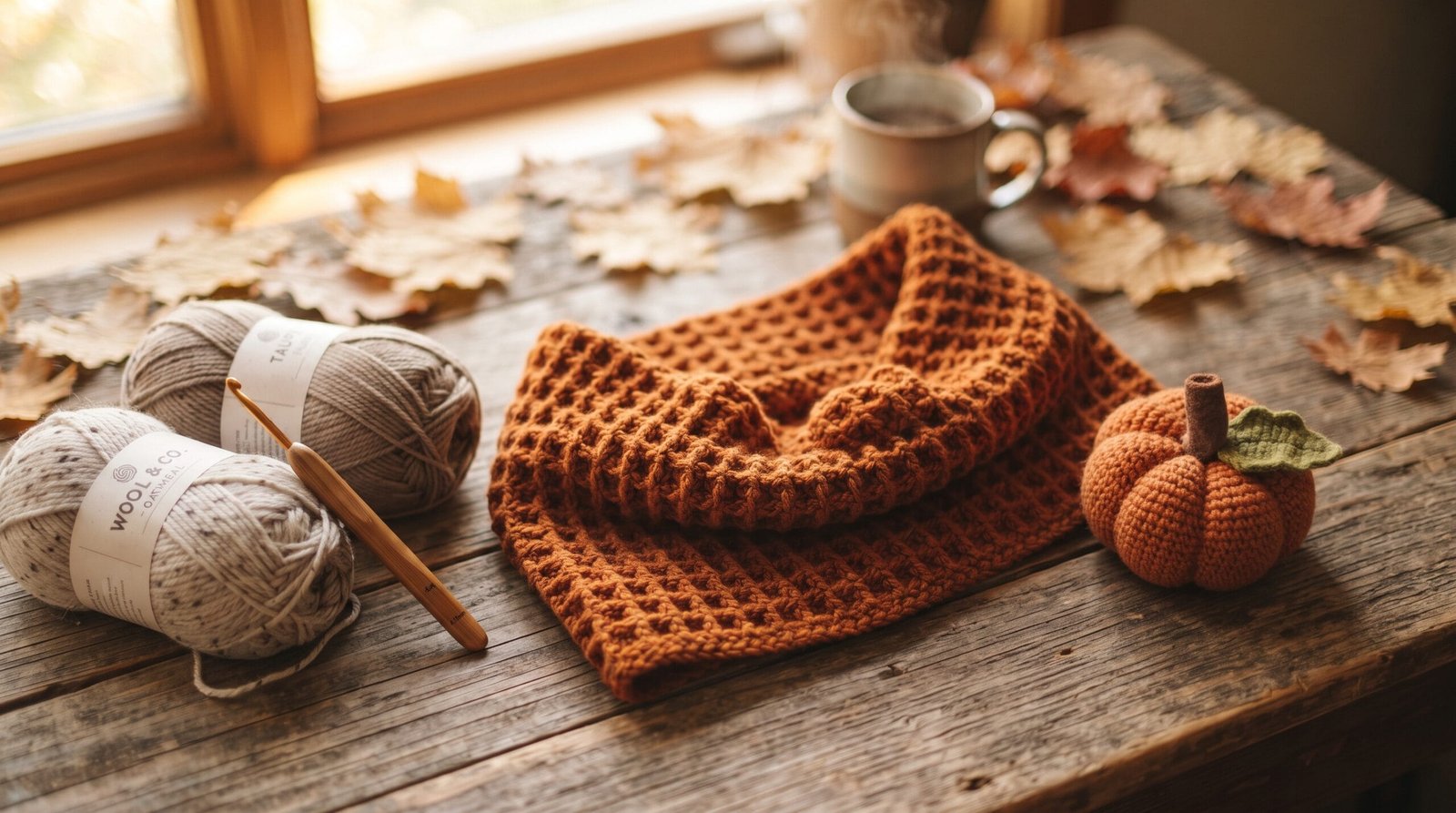
I start pulling out my rust-and-cinnamon yarn the same week the light changes — usually late September, when the afternoon sun goes gold instead of white. If you’re searching for fall crochet patterns, you’re probably feeling that same itch: something textured, something warm, something that doesn’t look like it belongs in July. This guide isn’t a single pattern. It’s the toolkit I actually use every autumn — the stitches, yarns, and color logic that make a project read as “fall” instead of just “brown.”
I’ve been crocheting for about eleven years, mostly amigurumi and garments at first, then home goods once I had a house with actual shelves to decorate. Fall is the season I look forward to most, because it’s the one time of year texture gets to do all the work instead of color alone.
What Actually Makes Fall Crochet Patterns Feel Different
Spring and summer crochet tends to lean on lace, cotton, and bright, flat color. Fall does the opposite. It leans on texture — stitches that cast shadows, yarn with a bit of halo or fuzz, and colors that shift depending on the light hitting them.
That’s really the whole secret. A pumpkin-orange granny square in cotton yarn under fluorescent light looks like a Halloween decoration. The same shade in a brushed acrylic or wool blend, worked in a textured stitch, looks like something you’d find in a cabin. The yarn and the stitch are doing more work than the color choice alone.
I learned this the hard way on my first “fall” project — a flat, single-crochet table runner in bright orange cotton. It looked less like autumn and more like a traffic cone. Swapping to a nubby wool-acrylic blend and a textured stitch fixed the problem completely, and I didn’t change the color at all.
Yarn Weight and Fiber for Autumn Projects
Weight matters more than most beginners expect. A worsted weight (Craft Yarn Council category 4) or a bulky (category 5) yarn drapes heavier and photographs “cozier” than a lighter DK or sport weight, even in the same colorway. If you want your autumn crochet projects to feel substantial — think blankets, cowls, mug rugs — start in that worsted-to-bulky range.
Fiber content changes the mood just as much as weight does. Here’s how I generally think about it:
- Wool or wool blends — best drape and warmth, takes texture stitches beautifully, slightly more expensive
- Brushed acrylic (“faux mohair” style yarns) — budget-friendly, adds a soft halo that reads as “sweater weather” even in a simple stitch
- Cotton — fine for coasters or dishcloths, but tends to look flat and summery unless you lean hard into a deep, muted colorway
- Chenille or velvet yarn — gorgeous for pumpkins and pillow accents, but splits easily and isn’t ideal if you’re newer to the craft
If you’re not sure which category your yarn falls into, the Craft Yarn Council’s standard yarn weight system is the reference most US pattern designers build their gauge notes around, and it’s worth bookmarking regardless of what you’re making this fall.
One more fiber note worth mentioning: superwash wool behaves differently than non-superwash wool in textured stitches. Superwash tends to relax and drape flatter after washing, which can soften a waffle or bobble texture more than you’d expect from the skein alone. If texture is the whole point of the project, a non-superwash or wool-acrylic blend will usually hold its shape better over time.
Tools and Notions Worth Having on Hand
Textured fall stitches are a little less forgiving than plain single crochet, so a few extra notions make the process smoother.
A locking stitch marker is worth keeping on your first stitch of every round if you’re working anything in the round, like a pumpkin or an acorn cap — it’s easy to lose track of where a round starts once bobbles are involved. I didn’t bother with markers for years and spent far more time frogging than I needed to.
A blocking mat and a handful of pins matter more for fall projects than people expect, especially for waffle stitch or granny-style squares that need to lie flat and square before seaming into a blanket. Textured stitches pull fabric in unevenly, and a quick wet block evens that out before you commit to sewing pieces together.
A tapestry needle with a bent tip is easier to weave ends through dense, textured stitching than a straight one — worth the few dollars if you’re making more than one or two pieces this season.
Fall Crochet Patterns for Beginners: Core Stitches to Know
If you’re newer to crochet, you don’t need a huge stitch vocabulary to get a convincing autumn look. Four stitches cover almost everything I make between September and November.
Moss Stitch (Linen Stitch)
This is single crochet and chain-one spaces, alternated so the stitches nestle into the gaps of the row below. It creates a woven, basket-like texture that’s forgiving of yarn imperfections — which is exactly why it works so well with the slightly uneven, rustic-look yarns that read as “fall.” It’s slow going compared to plain single crochet, but it’s genuinely one of the easiest textured stitches to learn.
The general rhythm, once you’ve chained a foundation: single crochet into a stitch, chain one, skip the next stitch, and repeat across the row. On the next row, you work your single crochet into the chain-one space from the row below rather than into the stitch itself, and chain one over the single crochet below it. That offset is what creates the woven look, and once your hands find the pattern it becomes almost automatic.
Waffle Stitch
Built from front post double crochet and regular double crochet in an alternating pattern, this stitch creates a raised grid that looks almost knitted. It’s one of my favorites for cowls and blanket squares because the ridges catch light and shadow in a way flat stitches never do. It does eat more yarn than a plain stitch, so budget accordingly if you’re working from a single skein.
Roughly, one common version alternates a row of all double crochet with a row that works front post double crochet around specific stitches from two rows below, leaving the others as regular double crochet. The exact placement varies by version, which is part of why I’d point a beginner toward a dedicated stitch tutorial with photos the first time through, rather than trying to learn it from written instructions alone.
Bobble or Cluster Stitch
Small clusters of stitches worked into one base stitch and pulled together — this is your “pumpkin ridges” and “acorn cap” stitch. It’s the single most useful technique for small fall-themed amigurumi shapes, and once you’ve made one bobble, you’ve essentially learned the whole technique.
The basic motion is: yarn over, insert your hook into the stitch, pull up a loop, yarn over and pull through two loops, leaving two loops on your hook. Repeat that three or four more times into the same stitch without finishing any of them off, then yarn over one final time and pull through all the loops at once. That last pull is what “closes” the bobble and gives it its rounded shape.
Basic Granny Square, Textured Variation
The standard granny square works fine for fall projects, but swapping the plain double-crochet groups for a puff stitch or a shell stitch instantly gives it more depth. This is a good place to practice if you already know the classic granny and want to push it further without learning a brand-new stitch from scratch.
If you’ve only ever made a traditional granny square, try converting just one round — leave the rest of the square as written, and swap the double-crochet groups in a single round for shell stitches (five double crochet into one space) instead. It’s a small enough change that you can back out of it if you don’t like the result, but it’s usually enough to notice a real difference in how the square reads.
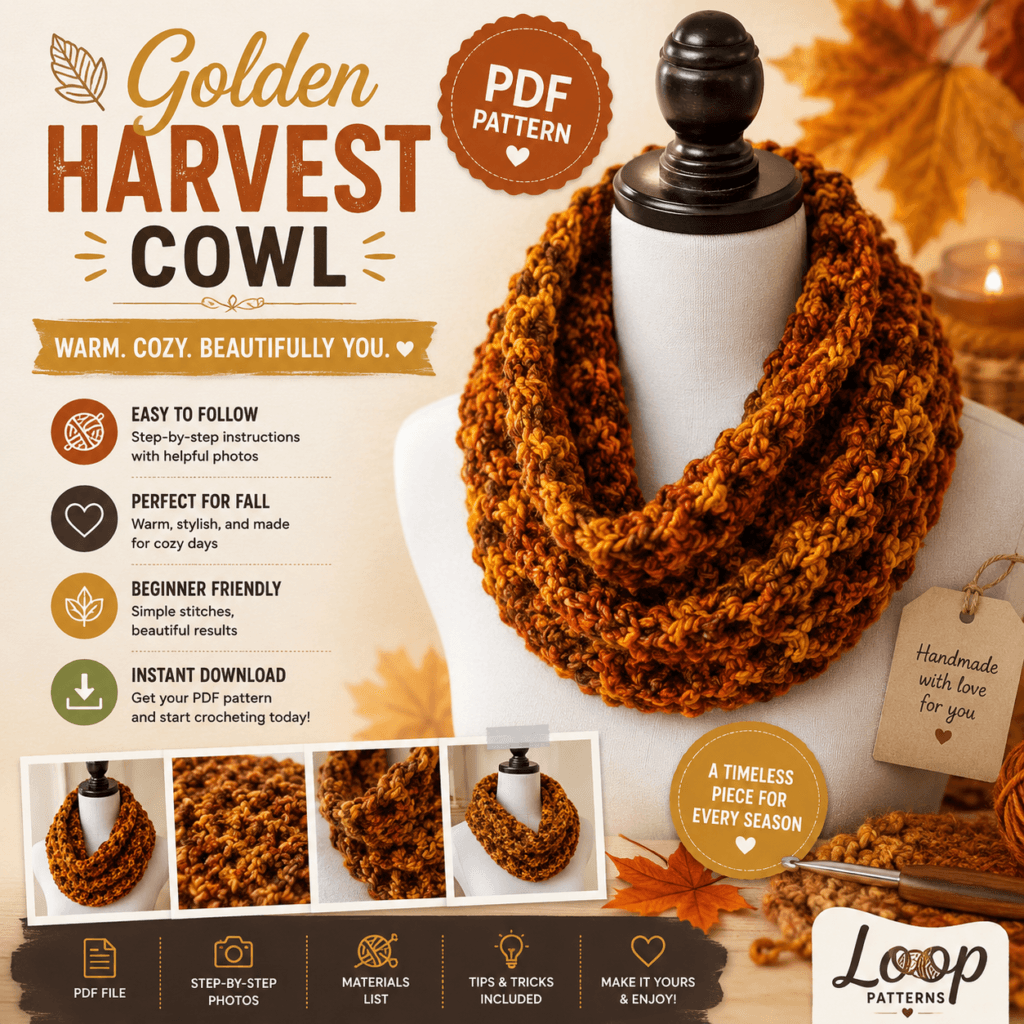
Golden Harvest Cowl Crochet Pattern PDF
Simple Fall Crochet Patterns Free to Try This Season
Since this is a technique guide rather than a single tested pattern, here are five project shapes I return to every year, along with the stitch and yarn approach I’d use for each. Treat the specifics — hook size, exact stitch counts, finished measurements — as a starting framework rather than a locked recipe; your gauge, yarn, and tension will shift the numbers.
Textured infinity cowl. Waffle stitch, worked flat and seamed into a loop, in a worsted or bulky wool blend. [Insert your tested gauge, hook size, and row count here before publishing a full pattern.]
Acorn appliqué. A small crocheted cap in bobble stitch over a plain stockinette-style dome for the “nut,” using a size H or I hook with worsted weight — small enough to finish in one sitting.
Mug rug or coaster set. Moss stitch square, roughly 4 to 5 inches, in a cotton-wool blend so it holds shape but still has a bit of texture.
Pumpkin softie. Rounds of half double crochet worked in vertical ribs (front post/back post alternating), stuffed and cinched at the top with a small applied stem.
Chunky throw blanket square. Waffle or shell stitch granny variation in bulky yarn, sized to your preferred finished throw dimensions and seamed with a simple whip stitch.
If you want a fully written-out, tested version of any of these with exact stitch counts, that’s a project for its own dedicated post — this piece is meant to be the toolkit you bring to whichever pattern you pick up next, tested or improvised.
Color Palettes That Read as “Fall” Without Looking Costume-y
The mistake I see most often — and made myself, more than once — is going straight to orange, orange, and more orange. A single skein of bright pumpkin orange against three neutral, muted shades reads as autumn. Four skeins of bright orange together reads as a Halloween costume.
My go-to combinations lean on one saturated color plus several muted supporting shades:
- Rust or pumpkin as the accent, paired with oatmeal, taupe, and a deep forest green
- Burgundy as the accent, paired with camel, cream, and charcoal
- Mustard as the accent, paired with warm gray, brown, and a dusty plum
Keeping the bright color to roughly 20 to 30 percent of the piece — a border, a set of stripes, a single motif — does more for the “fall” feeling than any stitch choice.
I keep a small notebook of yarn combinations that worked and ones that didn’t, mostly because I used to forget which specific rust shade paired well with which green until I’d already ordered more. If you’re buying yarn online rather than in person, ordering a single skein to test the combination against your other colors before committing to a full project is worth the extra few dollars and the wait.
Planning Fall Projects Around the Holiday Season
If any of your autumn-themed makes are meant to become gifts, timing matters more than people expect. A chunky throw blanket can easily take fifteen to twenty hours of actual hook time depending on size and stitch, which adds up fast once you account for a full-time job or family schedule around it.
I generally start gift-intended pieces by early October if they’re going out for Thanksgiving, and by late October at the latest for anything meant for the December holidays. Smaller pieces — coasters, a single acorn ornament, a mug rug — are much more forgiving and can realistically be finished in an evening or two, even started later in the season.
Common Mistakes I’ve Made With Fall-Themed Crochet
Beyond the traffic-cone table runner, my other recurring mistake is buying yarn under artificial light and being surprised at home. Rust and burnt orange in particular shift enormously between warm store lighting and daylight. I now always step outside or near a window before committing to a skein, even if that means asking a store clerk for a minute by the door.
The second mistake is skipping a gauge swatch on textured stitches specifically. Plain single crochet is forgiving; waffle and bobble stitches pull in tighter than you’d expect, and a blanket square that should be 8 inches can come out closer to 7 if you don’t check first. A quick 4-inch swatch saves a lot of frogging later.
Reading a Non-Seasonal Pattern With Fall in Mind
A lot of what I make each October isn’t from a pattern written with autumn in mind at all — it’s a spring baby blanket pattern or a summer market bag pattern, reworked. Learning to read a pattern for its bones rather than its stated season saves a lot of searching for something that technically doesn’t exist yet.
When I look at a new pattern now, I mostly ignore the photos and the suggested colorway and look instead at three things: the stitch used, the yarn weight called for, and the overall shape. A rectangle worked in double crochet is a rectangle worked in double crochet whether the designer photographed it in seafoam green for a nursery or cream for a wedding gift. The construction doesn’t change; only the yarn and stitch choice need to.
This is also why I’d encourage a newer crocheter not to wait around for a pattern labeled specifically for autumn. There are only so many of those published in a given year, and most of them use the same handful of shapes — cowls, throw blankets, granny squares, small stuffed shapes — that show up constantly in every other season too.
How to Adapt Any Pattern for an Autumn Feel
You don’t need a pattern specifically labeled “fall” to get an autumn result. Three swaps do most of the work:
- Swap a plain stitch (single or double crochet) for a textured one — moss, waffle, or a shell variation
- Swap a bright, single-tone colorway for a muted palette with one accent shade
- Swap a lightweight cotton for a wool blend or brushed acrylic, even at the same yarn weight
I use this approach constantly with patterns that were never designed with a season in mind. A basic granny square baby blanket pattern becomes a fall throw with nothing more than a yarn and stitch swap — the shaping and construction stay exactly the same.
Craft Room Tour
FAQ
Do I need special hooks for textured stitches like waffle or bobble stitch? No — your regular hook works fine. The main difference is that textured stitches are a bit harder on your hands over a long session, since you’re often working into the same stitch multiple times. Take breaks if your hands start to ache.
My bobble stitches look uneven. What am I doing wrong? Usually it’s tension on the last pull-through. Try loosening your grip slightly right before you pull the loop through all the stitches on your hook — a too-tight pull is the most common reason bobbles look squashed instead of round.
Can I use worsted weight yarn even if a pattern calls for bulky? You can, but expect a smaller, lighter-weight finished piece, and you’ll likely need a smaller hook to keep the fabric from getting too loose. It’s a fine substitution for a cowl or coaster; less ideal for a structural item like a basket.
Is brushed acrylic yarn hard to work with as a beginner? It’s a little trickier than smooth acrylic because the halo makes stitches harder to see clearly, which matters when you’re still learning to count. I’d suggest practicing a stitch first in a smooth, light-colored yarn, then switching to the brushed version once the motion feels automatic.
How much yarn should I buy if I don’t have an exact pattern yet? For a technique-based project without a locked yardage number, I generally buy one extra skein beyond my rough estimate, especially for textured stitches like waffle or bobble that use noticeably more yarn than a plain stitch of the same size. Most yarn shops and online retailers will let you return an unused, unwound skein if you overestimate.
Do fall-colored yarns fade or change over time more than other colors? Deep rust, burgundy, and mustard shades can be more prone to visible fading with repeated sun exposure than paler colors, simply because the fading is easier to see on a saturated dye. Storing finished pieces away from direct sunlight, and washing on a gentle, cool cycle if the yarn allows it, keeps the color truer for longer.
A Quick Note on Where to Go Next
If you’re looking for a full, tested project rather than a technique overview, my star blanket crochet pattern walks through a complete piece start to finish with exact stitch counts. This guide is meant to sit alongside it — less “here’s the one pattern to make” and more “here’s how I’d design or adapt any autumn-leaning pattern I pick up between now and December.”
Wrapping Up
Fall crochet patterns don’t need a huge stitch vocabulary or a mountain of new supplies. A textured stitch, a yarn with a bit of warmth to it, and a restrained color palette will get you most of the way there. Pick one stitch from this guide, one project shape, and one muted-plus-accent color combination, and you’ve got everything you need to start.
If you try any of these swaps on a pattern you already love, I’d genuinely like to hear how it turned out — drop a comment, or tag me if you share a photo. And if this was useful, passing it along to another crocheter gearing up for fall is always appreciated.