The first time I opened a real pattern, I thought I’d downloaded the wrong file. It was just letters. “Sc2tog, ch 3, sk next st, dc in next 4 sts, rep from.” I remember staring at it for a good five minutes before I understood that crochet abbreviations are basically shorthand, the same way a recipe says “tbsp” instead of “tablespoon.” Once that clicked, patterns stopped feeling like a locked door and started feeling like a language I could actually read. This guide walks through the abbreviations you’ll hit most often, how US terms differ from UK ones, and the mistakes I made early on so you don’t have to repeat them.
What Are Crochet Abbreviations, and Why Do Patterns Use Them?
Crochet abbreviations exist for one practical reason: patterns would be unreadable walls of text without them. A single motif might repeat “double crochet” forty times in one paragraph. Shorten it to “dc,” and the same instructions take up a third of the space and become far easier to scan while you’re mid-row, hook in hand, trying not to lose your place.
Most designers and publishers in the US follow a fairly consistent set of crochet abbreviations, which is a relief once you know it exists. You’re not decoding one designer’s personal shorthand every time you pick up a new pattern. You’re learning a shared vocabulary that shows up, with small variations, across books, magazines, and independent pattern shops alike.
That said, “fairly consistent” isn’t “identical.” Some designers write “sk” for skip, others write “skip” in full. Some abbreviate “stitch” as “st” and others spell it out in certain spots. It’s normal to keep a small reference list nearby until the common ones are second nature.
There’s also a practical printing reason behind all this shorthand that’s easy to miss. Pattern books and magazines were, for decades, priced and laid out by the page. Fewer words per instruction meant more patterns fit in a single issue, and that habit carried straight over into digital PDFs and blog patterns, even though page count stopped mattering in quite the same way. It’s a small piece of craft history, but it explains why the shorthand exists at all instead of every pattern simply being written out in plain sentences.
The Basic Crochet Abbreviations Glossary (US Terms)
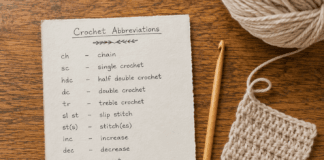
Below is the core list of US crochet abbreviations you’ll run into in nearly every pattern, from a simple dishcloth to a full sweater. I’ve grouped them by how often you’ll actually use them, because that’s how I wish someone had organized it for me back when I started. Unless a pattern specifically says otherwise, assume it’s using US crochet abbreviations, since that’s the default for the vast majority of American and Canadian designers.
Stitches you’ll use constantly:
| Abbreviation | Meaning |
|---|---|
| ch | chain |
| sl st | slip stitch |
| sc | single crochet |
| hdc | half double crochet |
| dc | double crochet |
| tr (or trc) | treble crochet |
| yo | yarn over |
| st(s) | stitch(es) |
| rep | repeat |
| rnd(s) | round(s) |
Shaping and structure terms:
| Abbreviation | Meaning |
|---|---|
| inc | increase |
| dec | decrease |
| sk | skip |
| sp(s) | space(s) |
| tog | together |
| beg | beginning |
| foll | following |
| cont | continue |
| rem | remaining |
| tch | turning chain |
Terms you’ll see in more detailed or textured patterns:
| Abbreviation | Meaning |
|---|---|
| fpdc | front post double crochet |
| bpdc | back post double crochet |
| blo | back loop only |
| flo | front loop only |
| MC | main color |
| CC | contrast color |
| WS | wrong side |
| RS | right side |
| pm | place marker |
| approx | approximately |
If you only memorize one table on this page, make it the first one. Those ten crochet abbreviations cover a huge percentage of what you’ll actually encounter, especially early on.
Gauge and Measurement Abbreviations You’ll See in the Materials List
Before the actual instructions even start, most patterns open with a gauge line, and it comes with its own small set of crochet abbreviations that are easy to skim past by mistake.
| Abbreviation | Meaning |
|---|---|
| gauge | how many stitches and rows fit into a set measurement, usually 4in/10cm |
| ndl | needle (used for weaving in ends or in tapestry crochet) |
| in / “ | inches |
| cm | centimeters |
| yd(s) | yard(s) |
| oz | ounces |
| g | grams |
| WPI | wraps per inch (a way to measure yarn thickness) |
I used to skip the gauge line entirely, assuming it only mattered for garments where fit is critical. That’s mostly true, but it also affects things like blanket size and how much yarn you’ll actually use. Reading those measurement abbreviations alongside the stitch abbreviations gives you a much more accurate picture of what you’re about to make before you commit an evening to it.
Crochet Abbreviations for Beginners: A Realistic Starting Order
I don’t think beginners need to memorize every entry in a master list before starting a project. That’s overwhelming, and honestly unnecessary. When I teach friends to crochet, I tell them to learn these crochet abbreviations for beginners in this rough order, because it mirrors the order most simple patterns actually need them:
- ch (chain) — nearly every pattern starts here.
- sc (single crochet) — the stitch most beginner projects are built from.
- st / sts (stitch/stitches) — you’ll see this constantly, attached to everything else.
- rep (repeat) — tells you a section loops back.
- sl st (slip stitch) — used to join rounds or move across stitches without adding height.
- hdc, dc — the next stitches up in height once sc feels comfortable.
- inc / dec — shaping words that show up the moment you make anything besides a flat rectangle.
Once those seven or eight terms feel automatic, the rest of the vocabulary builds on top pretty naturally. You’re not learning fifty unrelated words; you’re learning a small core set and then a handful of variations on it (front post, back post, and so on).
A Mistake I Made With “sk” vs. “sc”
Here’s a specific one, because generic advice about “reading carefully” never actually helped me. Early on, I misread “sk next st” as “sc next st” in a beanie pattern, because the letters look similar when you’re tired and reading by lamp light at 11 p.m. I single crocheted into a stitch I was supposed to skip. The result was a hat with a strange pucker on one side that I didn’t notice until I’d worked another four rounds past it.
I had to frog (unravel) back to the mistake and redo the section. Since then, I read skip and single crochet abbreviations out loud in my head as full words, not letters, especially late at night. It sounds small, but it’s saved me more than once.
US vs. UK Crochet Abbreviations: Don’t Mix These Up
This is where a lot of new crocheters get genuinely tripped up, and it’s not really their fault. The same abbreviation can mean two different stitches depending on which side of the Atlantic the pattern was written on.
The most important one to know: US “sc” (single crochet) is the same stitch as UK “dc” (double crochet). They’re not translations of the same word — they’re different stitches with overlapping letters, which is about as confusing as terminology gets.
Here’s a quick side-by-side:
| US Term | UK Term |
|---|---|
| single crochet (sc) | double crochet (dc) |
| half double crochet (hdc) | half treble (htr) |
| double crochet (dc) | treble (tr) |
| treble crochet (tr) | double treble (dtr) |
| double treble (dtr) | triple treble (trtr) |
| gauge | tension |
| yarn over (yo) | yarn over hook (yoh) |
If a pattern doesn’t specify which system it’s using, check the stitch count math. UK patterns tend to use taller stitches than US patterns for the same fabric density, and if something looks oddly loose or oddly dense compared to the photo, terminology mismatch is often the culprit. Most reputable pattern sources will state “US terms” or “UK terms” somewhere near the materials list specifically to prevent this confusion, so it’s worth a quick scan before you start.
Specialty Crochet Abbreviations You’ll Meet Eventually
Once you move past dishcloths and scarves into amigurumi, lace, or garment patterns, a second layer of crochet abbreviations shows up. These aren’t harder to understand, they just aren’t needed until you branch out.
| Abbreviation | Meaning |
|---|---|
| MR / AR | magic ring / adjustable ring |
| FO | fasten off |
| sc inc | single crochet increase |
| sc dec (or invdec) | single crochet decrease / invisible decrease |
| BLstst | back loop slip stitch |
| sc-blo | single crochet through back loop only |
| sk2p | skip 2, purl (occasionally borrowed into mixed crochet/knit patterns) |
| picot | a small decorative loop, often written “ch 3, sl st in first ch” |
| join | connect the working yarn to a new stitch, usually with a slip stitch |
| turn | flip your work to begin the next row |
Amigurumi patterns lean especially hard on “MR,” “sc inc,” and “sc dec,” because most stuffed toys are built in continuous spiral rounds shaped almost entirely through increases and decreases. If you’ve ever wondered why a tiny crochet animal pattern looks like a wall of two-letter codes, that’s why — the whole shape comes from combining just a few of these terms over and over in a specific order.
Lace and garment patterns bring in their own vocabulary too, things like “ch-3 sp” (chain-3 space) or “shell” written out as a bracketed group. You don’t need to memorize these in advance. They tend to show up with an explanation the first time a specific pattern uses them, and after two or three projects in a style, they stop needing translation.
Walking Through a Real Line of Pattern Instructions
Reading crochet abbreviations in a glossary is one thing. Reading them mid-row, under time pressure, with a toddler asking for a snack, is another. So let’s actually break down a sample instruction the way I’d read it out loud to a beginner:
*Row 4: Ch 1, turn. Sc in first 2 sts, sk next st, 5 dc in next st, sk next st, sc in next st; rep from * across, ending with sc in last st.
- “Ch 1, turn” — chain one stitch, then flip your work to start the new row.
- “Sc in first 2 sts” — single crochet into the first two stitches, plainly, no shaping yet.
- The asterisk marks where the repeating pattern begins.
- “Sk next st, 5 dc in next st, sk next st, sc in next st” — this is the “shell” shape: skip a stitch, fan five double crochets into the next one, skip another, then anchor it with a single crochet.
- “Rep from * across” — keep repeating that shell-and-anchor sequence for the rest of the row.
- “Ending with sc in last st” — the row’s final stitch breaks the repeat pattern, so you finish on a single crochet instead of mid-shell.
Once you can talk yourself through a line like that, almost any pattern using standard crochet abbreviations becomes readable, even in a stitch pattern you’ve never tried before. The letters are just a faster way of writing exactly what I described above in full sentences.
It’s worth doing this out loud, at least the first few times, rather than only in your head. Saying “skip a stitch, fan five double crochets” while your fingers actually do it builds a physical memory that sticks around longer than just reading the abbreviation silently ever does.
Compound and Combination Abbreviations
Once you’re comfortable with the basics, you’ll start seeing abbreviations combined into short phrases. These aren’t new stitches so much as shorthand instructions layered together, and they trip people up mostly because nobody explains the pattern behind them.
- sc2tog = single crochet 2 stitches together (a basic decrease)
- dc3tog = double crochet 3 stitches together
- ch-sp = chain space (the gap created by a chain, worked into rather than a specific stitch)
- fpsc = front post single crochet
- bpdc2tog = back post double crochet 2 together
- (3 dc, ch 2, 3 dc) in next st = a common way to write “shell” or “corner” instructions inside a stitch
Notice the pattern: a stitch abbreviation, sometimes a number, sometimes “tog” for together. Once you see that structure a few times, unfamiliar combinations stop being scary. You can usually work out “hdc2tog” even the first time you meet it, because you already know what “hdc” and “tog” mean separately.
How Punctuation Changes the Meaning
Crochet abbreviations don’t work alone — the punctuation around them carries real instructions too, and beginners often skim right past it.
- Asterisks (*) mark a section to repeat. “*Sc in next 3 sts, ch 1; rep from * around” means you loop that chunk of instructions, not just the last stitch.
- Parentheses ( ) usually group stitches worked into the same single stitch, like “(2 dc, ch 1, 2 dc) in next st.”
- Brackets [ ] often indicate a set of instructions repeated a specific number of times, written as “[dc, ch 1] twice.”
- Commas separate individual steps within a row or round.
I ignored asterisks completely on my second-ever project (a simple granny square) and just crocheted the whole row in a straight line instead of looping the repeat. It came out as a long strip instead of a square. Learning to actually pause at that little star symbol probably saved me more frustration than memorizing any single abbreviation did.
A Quick Way to Actually Memorize These
Flashcards work, but I’ll be honest: what worked better for me was writing the full word next to the abbreviation in the margin of my first few printed patterns, every single time, until I didn’t need to anymore. It’s slower in the moment and faster in the long run.
A few other things that helped:
- Keep a small abbreviations chart taped inside a project bag or notebook you actually use.
- When you hit a term you don’t know mid-row, write it in full above the abbreviation in pencil rather than looking it up and immediately forgetting it again.
- Practice on scrap yarn using only the term (not the abbreviation) out loud, then switch to reading the shorthand once the stitch itself feels automatic.
- Group new crochet abbreviations by the project type you’re currently making. You don’t need amigurumi terms while you’re working a simple scarf, so there’s no reason to try to absorb all of them at once.
- Re-read the pattern’s own abbreviation key before you start, even if you think you know every term. Designers occasionally use a less common word for something familiar (calling a decrease “dec” in one place and spelling out “decrease” a paragraph later), and catching that early saves you a frog session down the line.
None of this needs to happen overnight. I still keep a printed abbreviations chart in my project bag, years into this hobby, mostly for the specialty terms I don’t use often enough to have fully memorized. That’s normal. Pattern designers assume you might need to check, which is exactly why the abbreviation key exists at the top of nearly every pattern in the first place.
If you want a deeper breakdown of how all of this fits together inside a full pattern — stitch counts, gauge swatches, and reading a row-by-row layout from start to finish — I’ve gone into more detail in how to read a crochet pattern step by step on the blog, which pairs well with this list.
For the full official reference, the Craft Yarn Council maintains a standardized master list that most US pattern designers follow, and it’s worth bookmarking for anything this guide doesn’t cover: Craft Yarn Council’s Crochet Abbreviations Master List.
FAQ
Do I need to memorize every abbreviation before I start my first project? No. Learn the handful that show up in whatever pattern you’re actually working on first. The rest sink in naturally as you make more things.
Why do some patterns spell out “skip” while others write “sk”? It comes down to the individual designer’s or publisher’s house style. There’s no universal rule forcing every abbreviation to be shortened; some writers just prefer full words for clarity in certain spots.
Is it okay to write my own shorthand notes on a printed pattern? Yes, and I’d actually recommend it. Writing the full word above a confusing abbreviation, or circling repeat markers, is exactly the kind of thing that speeds up reading the next similar pattern.
Are crochet abbreviations the same in every country? The core letters are largely consistent across US sources, but UK, Australian, and some other English-language patterns use a different naming system for stitch height, which changes what several of the same letters mean. Always check which system a pattern is using before you start.
What should I do if a pattern uses an abbreviation that isn’t explained anywhere? It happens more often than you’d think, especially with older or self-published patterns. Check the very top of the pattern first, since most abbreviation keys live there. If it’s genuinely missing, a quick web search for the exact abbreviation plus “crochet” almost always turns up an answer, since it’s likely a standard term the designer just forgot to define.
Do amigurumi patterns use different abbreviations than clothing patterns? Not entirely different, but amigurumi leans heavily on a smaller set repeated constantly (MR, sc inc, sc dec, FO) because most toys are worked in continuous rounds. Garment and lace patterns pull from a wider vocabulary, including shaping and stitch-space terms you’ll rarely see in a stuffed toy pattern.
Wrapping Up
Crochet abbreviations feel like a foreign alphabet for about the first three patterns, and then, almost without noticing, they stop requiring translation at all. The letters just become the words in your head. If you’re still in that early stretch, keep this list nearby, read patterns slowly on purpose, and don’t skip the punctuation — it’s doing more work than it looks like.
Give yourself permission to reread a line two or three times before you pick up your hook, especially on a new stitch pattern. That’s not a sign you’re bad at this. Even after years of crocheting, I still pause on unfamiliar combinations, and slowing down for thirty seconds is always faster than frogging half a row later.
If this helped untangle your first pattern, I’d love to hear which abbreviation confused you the most when you started. Drop it in the comments, or share this with a friend who just picked up a hook for the first time.